I dream in a language I do not understand when I’m awake
I read Dictionary of the Khazars in a week. I would not recommend doing that.
I also read it cover to cover. I would most definitely not recommend doing that. It’s a book that rewards wandering, flipping, rereading, going where the flow takes you. It calls to mind the “choose your own adventure”-books I read as a child, and cover to cover is not it.
I’m not really sure how I feel about this book. I chose it because it was described as something of a national sensation in Serbia, but I honestly mostly sat with a feeling of not being smart enough to get this book at all. (And I do consider myself pretty smart, thank you very much!)
I also developed a bit of an an urge to sit the author down and ask him if he is OK?
Because this, my friends, is a WILD book.
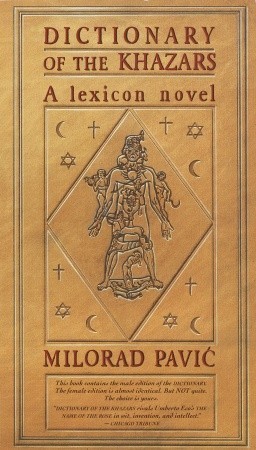
It calls itself a lexicon novel and consists of entries from three different religious sources: the Christian, Islamic, and Jewish books. These sources don’t always agree with each other, and they don’t form a narrative in any traditional sense. There are two editions of the book, male and female, differing by just one sentence. I read the female version.
To say this book defies genre is putting it mildly. It’s part historical fiction, part fantasy, part theological puzzle, and entirely experimental. You can’t trust the narrators. You can’t rely on chronology. You can’t even rely on reality. The narrative loops through dreams, identity shifts, mysticism, and religious and metaphysical musings. It also skips between three timelines: Middle Ages, 17th century, and modern 20th century. Every lexicon entry seems to undo or contradict another. Every time I thought I was grasping some kind of truth, the ground shifted again.
When we read, it is not ours to absorb all that is written. Our thoughts are jealous and they constantly blank out the thoughts of others, for there is not room enough in us for two scents at one time.
I kept reading hoping that something would start to make sense for me, but it honestly never really did. I felt completely out of my depth most of the time and I was constantly unsure what was real and what was dream. Dreams play a very important part in the book.
I did grasp the main idea: Dictionary is the imaginary book of knowledge of the Khazars, a people who flourished somewhere beyond Transylvania between the seventh and ninth centuries. And once upon a time the Khazar ruler had a dream, that God was not happy with him. He called upon representatives of the three main religions to explain this dream to him, and promised to convert to whatever religion did it best. Spoiler: The three accounts all say that he eventually chose their religion.
But that is actually just a side plot in the book, which contains an extremely colourful cast of characters and whirlwind of tales in varying degrees of strange and unsettling. I did spot certain ideas or themes repeating: Dreams, identity, religion, language. But I couldn’t quite get a hold of them, and I do think maybe that’s the point exactly.
I could see the bird soaring away. And then I realised there was no more shutting of your eyes to the truth, no salvation in being blindfolded, no dream and reality, no being awake or asleep. Everything is one and the same continuing eternal day and world, coiling around you like a snake. This is when I saw vast, remote happiness as being small but close.
That said, there’s something fascinating about how utterly different this book is. I’ve certainly never read anything like it, and even though maybe I didn’t “get” it, I wasn’t bored. Confused and frustrated, yes. But also strangely intrigued through the whole thing.
I’m glad I read it. It’s one of the few books in this project so far I have bought in a physical copy, so it is on my shelf now, and I might even get back to it at some point. If you’re the kind of reader who enjoys experimental structures, endless ambiguity, and not knowing what on earth is going on, then Dictionary of the Khazars might be an adventure worth taking.
Just… maybe not in a week. And definitely not cover to cover.
And if you think this is entirely too strange, try another book from Serbia!