Man is a wild beast, and wild beasts don’t read.
(This review contains spoilers)
Let’s go with the classic this time, I thought.
Zorba the Greek felt like the obvious pick for Greece. It really doesn’t get more Greek than this classic novel by Nikos Kazantzakis. I chose the audiobook, and it turned out to be a perfect fit. The narrator captures Zorba’s energy so very well, giving voice to his charisma, boundless appetite for life, and unapologetically blunt worldview.
“Look, one day I had gone to a little village. An old grandfather of ninety was busy planting an almond tree. ‘What, grandfather!’ I exclaimed. ‘Planting an almond tree?’ And he, bent as he was, turned around and said: ‘My son, I carry on as if I should never die.’ I replied: ‘And I carry on as if I was going to die any minute.’ Which of us was right, boss?”
The story begins when an unnamed academic narrator (Greek, not British as I somehow assumed … maybe I was thinking of the film, which I’ve actually never watched?) decides to leave his intellectual life in the city and travel to Crete to open a lignite mine he has inherited. At the port he meets Alexis Zorba, a wandering worker with a colourful past, a love of music and women, and an unmatched gift for storytelling. Impulsively, the narrator hires him as a foreman, and the two head to a remote coastal village on Crete.
From here, the novel unfolds as a series of vivid encounters, long conversations, and bold events. Zorba throws himself into the lignite mine project, tells one outrageous story after the other, and constantly challenges the narrator’s overly intellectual and cerebral approach to life. While the narrator reads Dante on the beach and ponders existentialism and religion, Zorba dances, eats, drinks, and flirts shamelessly with the aging Madame Hortense (a retired courtesan who’s still dreaming of grand love affairs with four admirals). And practically despairs when the narrator does not immediately give in to his carnal attraction to the beautiful young widow in the village.
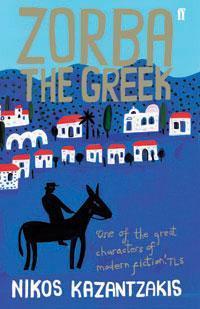
Kazantzakis’ writing is superb. It’s poetic and bold and fun. You can feel the sun on your face and the scents of thyme and orange blossoms. And the character of Zorba is simply larger than life. He is passionate, sensuous, unfiltered and deeply pragmatic. He feels everything with intensity and has no time for overthinking. And I loved it.
And there is so much wisdom in this book. Told bluntly from Zorbas perspective, or with care and fine words from the narrator. Some of the meandering philosophical musings of the narrator did get a little too much for me personally at times, but It really is the kind of story that makes you want to throw away your books altogether and jump on the first flight to Crete, to drink wine and dance barefoot in the mountains.
“I hope you don’t mind my saying so, boss, but I don’t think your brain is quite formed yet. How old are you?’ ‘Thirty-five.’ — ‘Then it never will be.’
But as beautiful as the prose and as compelling the character of Zorba is, I do have to mention that large parts of the book is deeply problematic by today’s standards. The book is undeniably deeply sexist, and Zorba’s views on women are… a lot. Almost every page includes some wild generalization about “the female of the species” that would make most modern readers choke on their matcha latte. Women are simply not treated as full people in this story. Zorba even wonders out loud if they are actually human. When the young widow dares to defy social expectations, the entire village brutally murders her. And then the plot just moves on as if nothing happened. I was rather horrified.
Too much for you? Try another book from Greece!
And speaking of plot … There are some wild, unexpected moments (a mentally unstable monk sets fire to a convent. Zorba applauds, I’m slightly appalled), more than a few homoerotic undertones woven into the letters between the narrator and his old friend who is fighting a war in the Balkans (there’s a part of history there I’m not clear on), and sparks literally fly as Zorba attempt to transport timber using a homemade tree-log cable car contraption. In the end, the business fails spectacularly, the dream collapses, and Zorba disappears as quickly as he arrived.
So yes, the gender politics are cringe-worthy, the philosophical detours sometimes tedious, and the moral compass a bit unhinged … but I loved Zorba. I loved the Greek spirit.
Life is chaotic, brutal and beautiful. Stop and smell the orange blossoms.
And learn to dance.