A man who does not know his past is a child
On paper, this was the perfect pick: a major Central Asian writer, a novel rooted in Uzbek literary history, something clearly ambitious and culturally very significant. A book showered with literary awards. Exactly the kind of book I want to discover on this journey.
And it is, without question, one of the most intellectually ambitious books I’ve encountered on this journey. It is dazzlingly constructed, deeply researched, and clearly the work of a brilliant writer in complete command of his material.
And yet … Reader confession time.
This was hard work!
If you’re not up for hard work, maybe a different book from Uzbekistan?
It took me forever to read this book. I had to reread passages. I paused often and read something else. And more than once, I had the thought: Maybe this one just isn’t for me. This might be the closest I have come to DNF’ing a book on this journey so far.
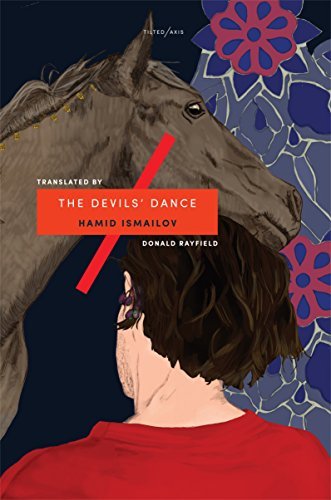
The main character of The Devil’s Dance is Abdulla Qodiriy, who was a real-life Uzbek writer and national literary figure. (One of his books was on my list). We follow him during the final months of his life in 1930s Soviet Uzbekistan.
During Stalin’s purges, Qodiriy is taken from his house by the Soviet secret police and thrown into a prison in Tashkent. There he is brutally beaten and sits for months awaiting interrogation, judgment, and almost certain death. We see the interrogations, the waiting, the tense conversations with fellow prisoners, most of whom are academics like himself. And we experience the slow psychological pressure of a system specifically designed to break people down.
There is a constant sense of dread hanging over these sections. Qodiriy, and hence the reader, understands perfectly well what tends to happen to writers and intellectuals caught in the machinery of the late 1930s Soviet state.
But that is just one layer of the novel. And for me personally it was not the most interesting one.
“All those who are left behind either recite their prayers or weep quietly. Or sit together, unable to settle down and go back to sleep until morning comes. Everyone knows the fate of those who are taken out at that early hour.
The translator in the afterword says that this is a two-for-one novel. Because to survive the endless waiting, Qodiriy works on a historical novel in his head. His novel centres on Oyxon, an early 19th century Uzbek female poet, who was forcibly married to three khans in a row.
This second narrative takes us into a colourful Central Asian world of ruthless khans and emirs, harem intrigue, spies, beautiful women, dangerous court dynamics, shifting loyalties and cold-blooded murders.
The book jumps back and forth between the Qodiriy’s present and the story he is writing with no warning and in increasingly shorter sections. Gradually, echoes begin to appear between the past and present. And as he slowly loses his grasp on reality, the lines between the two narratives become ever more blurry.
And the story becomes ever more difficult for this bookworm to grasp.
Usually a narrative begins to move towards its end after the climax, the knots have been unravelled, the complications have been simplified. But life around the novel (if only you could call it life!) was restoring the tangles and knots, and was doing all it could to make more and more obscurity out of the clarity.
And another thing. Almost every single page of this book contains lines of classic Uzbek poetry, and I was acutely aware at all times that there were literary and cultural references flying past me that I simply am not equipped to decode.
I could see the shapes here. I could tell there was something profound and important was happening underneath. But I clearly only scratched the very outermost layer of what Ismailov was building. This feels like the kind of book that demands an entire college course to even begin to grasp it. And I kind of want to take that college course!
If anything, this was a powerful reminder that Uzbek literature, like so many literary traditions we don’t see often in translation, is complex, layered, and deeply rooted in its own history.
This book is a very very demanding read. And while I may not have understood the movements of the dance… I’m honestly still glad I stepped onto the floor.