
Fried greens, no oyster sauce
I was completely absorbed by this one.
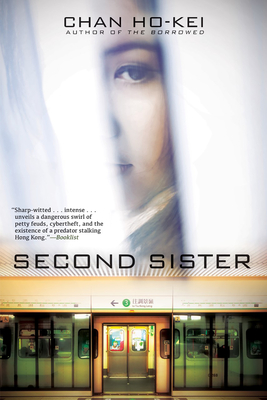
The kind of absorbed where the world around you fades a little and you look up, slightly startled, when someone speaks to you, because you were just eating noodles in a dilapidated apartment in Sai Ying Pun, Hongkong, while a a brilliant hacker was explaining digital footprints to you.
It is the kind of novel that will have you seriously consider deleting all of your social media and almost make you afraid to open your laptop. It’s a book that makes you question reality just a little bit.
Human beings naturally love expressing their opinions more than they want to understand other people. We always talk too much and listen too little, which is why the world is so noisy. Only when we understand this will we finally see progress in the world.
But we open with an absolutely heartbreaking scene: A 15 year old schoolgirl, Au Siu-Man, is found dead at the foot of the public housing block where she lived on the 22nd floor.
Suicide, the police says.
Her older sister, Au Nga-Yee, a 25 year-old librarian, who has been Siu-Man’s only family after both of their parents died, refuses to accept that it was simply suicide. Yes, Siu-Man was groped by a man on the MTR the preceding year and later targeted by a cyberbully. But she seemed to have gotten over it, and Nga-Yee assumed that she was fine.
Convinced that something, or someone, pushed her sister over the edge, she sets out to find the truth.
To do so, she hires the brilliant, mysterious hacker known only as N. One of the best written characters I’ve seen in quite some time! Morally ambiguous and calmly ten steps ahead of everyone else in the room at all times. I absolutely adored him.
N is not easily convinced to take the case, but when he does, we embark on a tour de force of cutting edge technology, hacking, psychological and social engineering, hat-and-mustache disguise and good old fashioned sleuthing. He traces hidden digital footprints and unravels a network of secrets to find out who pushed Siu-Man to her death.
And everything is of course more complicated than it seems.
Nga-Yee bumbles along on the sidelines. Her character I did not love as much. I understand that she is meant to be grieving, out of her depth, desperate. And that her ignorance is a narrative tool to let N explain what’s up. But at times she felt almost comically slow on the uptake. Her almost complete lack of technological awareness stretched plausibility for me. Not everyone needs to be tech-savvy, but that a 25 year-old in Hongkong does not know what a Wi-Fi is seems a little exaggerated. She’s often written like she’s middle aged. It didn’t ruin the book for me by any means, but it did make me roll my eyes a few times.
Running along N and Nga-Yee’s mission is a second, and at first completely separate, narrative. A man working at a small digital start-up is trying to secure investment from a large US venture. And mostly trying to advance his own situation in the world by any means necessary. The dual narrative felt slightly disorienting at first. I was very much invested in both stories, but it’s not immediately clear how everything connects. Which of course this is very deliberate, and when it all clicks into place, it is immensely satisfying. Some of the final twists genuinely gave me chills.
Earning money was a means to an end: to support the household and let her family live happily. But capitalist society lulls us into believing our wages are a goal in themselves, turning us into slaves of money. We forget that as crucial as money may be, there are even more important things that we can’t afford to lose.
The story could have taken place anywhere in the world, but the image of Hong Kong is extremely vivid. I don’t know if it’s because I’ve actually visited Hongkong in person, but the sense of place was incredible in this one. The city comes alive, and the amount of street names and place descriptions makes it basically a tourist guide.
Second Sister unfolds like a mystery and a revenge thriller. There are good guys and bad guys and secrets to unravel. But the main theme is the impact of technology on modern life. How anonymity online can harm real lives and how cyberbullying, fake news, and social-media mob culture contribute to psychological trauma. Chan Ho-Kei digs into how technology shapes identity, power, and truth. The technical explanations are detailed (sometimes almost ridiculously so), and the nerd in me loved every second of that.
We also get a taste of income inequality, housing struggles, and corporate negligence. The book is definitely meant as a very clear commentary on capitalism and its pitfalls.
All in all it a chilling and relevant exploration of today’s society. A smart, unsettling, and thoroughly absorbing techno-thriller, which is also somehow deeply human. And for me personally there’s just something wildly satisfying about watching someone who truly understands the system manipulate it.
Highly recommended.
But if you insist, here are some other options for Hong Kong.