I told you stories to give you wings
This book is utterly heartbreaking.
And ubelievably beautiful.
If you already know you want something else, maybe try one of these..
I knew, in broad strokes, about the Khmer Rouge and the Killing Fields before picking this up. But much like with several other books on this reading journey, I realised very quickly that knowing historical facts is not the same as emotionally understanding what people actually lived through.
And just like The Mountains Sing from Vietnam, this book makes you feel it.
In the Shadow of the Banyan follows young Raami, the 7 year old daughter of a royal Cambodian family, whose entire world collapses when the Khmer Rouge takes power in 1975. One moment she is living in a gated palace in Phnom Penh surrounded by stories, poetry, and privilege. The next, her family is forced out of the city along with everyone else and sent into brutal rural labour camps.
I had learned not to be afraid of owls and other night creatures. Animals are not like people. If you leave them alone, they won’t hurt you. But people will, even if you’ve done no wrong. They hurt you with their guns, their words, their lies and broken promises, their sorrow.
From there, her life becomes a constant struggle for survival.
Hunger. Forced labour. Fear. Separation. Disease. Disappearances.
Intellectuals, educated people, former officials, anyone associated with the old Cambodia suddenly becomes dangerous, because “The Organization” has decided this is the case.
And because Raami is a child, she never understands the politics behind what is happening around her. Which somehow makes the story even more devastating.
The book does not explain the Khmer Rouge regime in political detail, or at all. Pol Pot is never looming over the story as some grand villain. Instead, the horror exists in the background of everyday life. In exhaustion, in starvation, in the terror of “The Organization” deciding your every move.
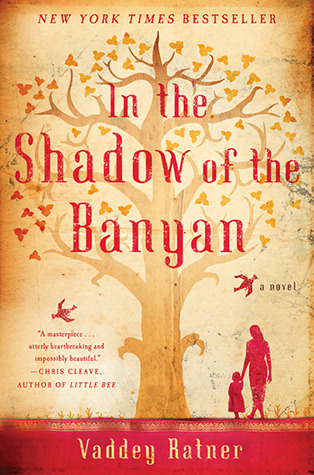
But what makes Vaddey Ratner’s tale so special is that it refuses to let the horror become the entire story.
Because In the shadow of the Banyan is also filled with beauty.
Raami’s father, The Tiger Prince, is a poet, and he has taught her to notice the beauty still present in the world, even in the middle of unimaginable suffering. Stories, folklore, Buddhist beliefs, spirits, the Cambodian landscape, the rice fields, the banyan tree itself … Everything is woven together into something almost dreamlike at times.
And for me that contrast between the beauty and the brutality makes the emotional impact even stronger. There were sections that genuinely made me tear up.
I especially loved how deeply rooted the novel feels in Cambodian culture and spirituality. The myths, the traditions, the stories passed between generations, gives the novel such warmth and humanity even while portraying some of history’s worst atrocities.
Often I lose myself in the constellation of my own ideas, forever searching for point of illumination. But no matter where I look, I find you, shinning and bright, offering me what ever it is I seek, you are my one single star. My sun, my moon, my guide and direction, I know as long as I have you, I’ll never lose my way. Even if I cannot touch you, I know I will see you, feel you, from anywhere. If I need you I know where to find you.
And underneath everything else, this is really a story about family.
About parents trying desperately to protect their children in a world that has gone mad. About storytelling as survival. About holding onto humanity when everything around you is determined to strip it away.
If I have one tiny criticism, it’s maybe that Raami occasionally sounds a little older and wiser than a child her age realistically would. Some of the reflections feel very mature for a girl experiencing these events in real time.
But I did not care. I was completely swept away by this novel.
It’s horrifying, yes. It has some of the most devastating and brutal scenes I have ever read. But it is not horror for the sake of it. Not manipulative. It feels real, compassionate, poetic, tender, and deeply moving. One of those rare historical novels that manages to portray terrible suffering without ever losing sight of beauty, love, and human dignity.
Raami’s story is fictional, but is in broad strokes Vaddey Ratner’s own story. She herself is the daughter of a Cambodian Prince, and was five years old when the Khmer Rouge took control of the country. Her afterword is one of the strongest parts of the book, but I will not spoil that for you.
An absolutely unforgettable read.