
We missed mother
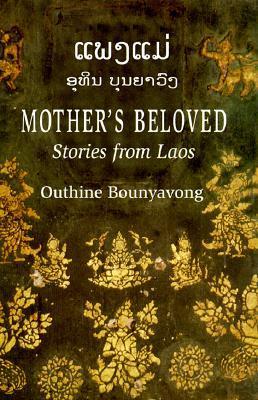
For Laos, I picked up Mother’s Beloved, a collection of fourteen short stories by Outhine Bounyavong, written between the late 1960s and 1990.
The book is printed in both Lao and English, with the original text on one page and the translation opposite. Since I obviously don’t read Lao, that might seem like a strange feature to appreciate, but I did find myself spending some time looking at the beautiful and elegant Lao text, so completely unlike the alphabets I am used to.
Reading the stories themselves were a more … mixed experience.
Bounyavong’s focus is on ordinary people living ordinary lives in villages and small communities. There are farmers, labourers, young people looking for love, families struggling with poverty, and people trying to navigate the challenges of everyday life.
My mother taught us that if we are carrying food with us when we see a pregnant woman, we must give her a share. No matter how much or how little,
we must give her some of it.
The writing is straightforward and understated, without any dramatic flourish whatsoever. I would almost describe it as simplistic and naive in style. With the exception of the last few stories, which felt a little more embellished to me.
Unfortunately, for me personally the simplicity of the writing worked against the stories rather than for them. I don’t know if some of it can be blamed on the translation, but the prose felt deliberately bleak and matter-of-fact, and quite honestly most of the stories left me more bored than moved.
In addition most of them carry a moral lesson that feels extremely heavy-handed to me.
But there is a reason for that.
Laos remains one of the world’s few communist states, and the collection includes an introduction explaining some of the history of modern Lao literature. During much of the communist period, writers were state employees and publication was strictly politically controlled. Literature was expected to educate, inspire and support the values of society. Subtlety and ambiguity was not encouraged.
So these stories don’t exactly invite the reader to wrestle with difficult questions. Instead they throw the answer directly in your face. The hardworking and virtuous are rewarded. The selfish are punished. The loyal patriotic citizen sees qualities that others overlook.
The village dance story is probably the clearest example. A poor girl is ignored while the prettier and wealthier girls attract all the attention. Years later, she has built a good life for herself, while the girls who once mocked her have either fled the country or ended up in re-education camps. The only person who was kind to her back then turns out to have been a member of the revolutionary guard.
The message is not exactly subtle!
One tells of a young man who thinks cycling is very hard, until he discovers the joy of being able to give strangers a lift. (With the exception of young women who might take it the wrong way. Obviously).
Another tells of a shoemaker who complains at length about a customer who never returns to collect his expensive shoes, only to discover that the man has lost a leg fighting for his country. Upon discovering this, of course the shoemaker hands over the mended shoes for free and feels a deep joy of being able to support the patriotic war against Thailand in this way.
And on and on it goes with lessons like these.
So. Even while I wasn’t particularly enjoying the stories, I still found them fascinating as glimpses into a society and literary tradition I knew precisely nothing about. They are not really meant to be enjoyed as fiction, but simply vessels to pass on values and ideals.
One of the stories that stood out a little to me centers on the devastation by the heavy bombardment of Laos in the 1970s, when the United States dropped 2.1 million tons of bombs on the country over 9 years. This story had me studying Plain of Jars, an archeological site I had never heard of before.
Ruins and bomb craters everywhere. The bare branches of a single blackened tree stood on a hillside, as if guarding the silence. Not only was this land made uninhabitable for human beings, but also for animals. Unexploded bombs still lie buried in the Plain of Jars. Death lurks underground, everywhere.
I can’t truthfully say that Mother’s Beloved was a book I loved, but neither was it a complete disappointment. More than anything, it was an opportunity to spend time inside a completely foreign literary tradition that is rarely translated. Correct me if I’m wrong, but I still believe it is the only book by a Lao author available in English!
But there are some other books set in or connected to Laos.
Sometimes this project is about finding a wonderful book. Sometimes it’s about understanding a country a little better.
For me, Mother’s Beloved was very much the latter.