Any man who is truly worthy must consider himself unworthy
Read it already? Try another book from Vatican City!
The Papal Conclave is the centuries-old process by which the College of Cardinals elects a new pope. It takes place in strict secrecy within the Vatican — specifically, inside the Sistine Chapel. Once the doors are locked, the cardinals remain cut off from the outside world until a decision is reached. Voting continues in rounds until one candidate receives a two-thirds majority. After each round, the ballots are burned: black smoke signals no decision, while white smoke announces the election of a new pope. The word conclave comes from the Latin cum clave — “with a key” — a nod to how the electors are literally locked in until the new pontiff is chosen.
And with a real-life Conclave starting in the Vatican this week, it feels like the perfect moment to share the book I read for the smallest country in the world.
Finding a novel by a native author from Vatican City was, quite frankly, an impossible task. With fewer than a thousand residents — most of them clergy, diplomats, or Swiss Guards — the world’s smallest country doesn’t exactly have a bustling literary scene. So I broadened the criteria and went with something set entirely within the Vatican walls. That led me to Conclave by British author Robert Harris — and I ended up loving it far more than I expected to.
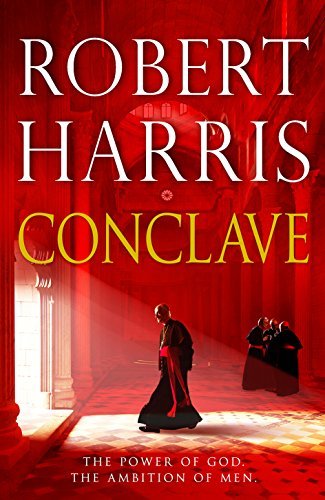
Conclave begins with the death of a fictional pope and follows the tense days leading up to the election of his successor. The cardinals are sealed off from the world inside the Sistine Chapel. No phones. No press. No contact with anyone outside. Just ancient ritual, personal ambition, and a rising sense of uncertainty as secrets begin to surface. I didn’t expect to be so thoroughly drawn in — but this book was like watching a thriller and I practically read it in one sitting.
The novel unfolds over just a few days, but the atmosphere is thick with intrigue. At the heart of the novel is Cardinal Lomeli, the Dean of the College of Cardinals. He’s a man of conscience — thoughtful and not power-hungry, which makes him stand out in a room full of political maneuvering. He’s also quietly troubled: not only by his own doubts and weaknesses, but by the slow realization that the process unfolding around him may be far more compromised than he imagined. Watching Lomeli wrestle with questions of truth, responsibility, and faith gave the novel a layer of emotional weight I hadn’t anticipated.
Around him, Harris assembles a cast of vivid characters: Cardinal Tedesco from Italy, aging and intellectual, the candidate of choice of the liberal wing of the Church, the ideological successor of the late pope, and the initial favorite to win the election. Cardinal Tremblay from Canada, a slick Vatican insider, ambitious, news media-savvy candidate with a PR machine behind him. Cardinal Adeyemi from Nigeria, a traditionalist candidate backed by the other African cardinals, charismatic and discussed in the press as having a viable path to becoming the first black pope despite his militant opposition to homosexuality. And finally Cardinal Vincent Benítez, a Filipino whose arrival to the conclave comes as a surprise; him being achbishop of Baghdad and appointed cardinal in secret by the late pope shortly before his death. Each one brings a different vision of what the future Church might look like.
And before the final vote, we are witness to a series of secrets and revelations that threaten to shake the process, the people — and the Church — to its core.
But I will not spoil any of this for you, because you deserve to read it for yourself!
No one who follows their conscience ever does wrong… The only guide to a person’s actions can ever be their conscience, for it is in our conscience that we most clearly hear the voice of God
Even though the novel is entirely fictional, it’s full of real-world detail, from the inner workings of the Conclave to the balance of global Church politics. I kept Googling to see what was true. (Answer: quite a bit.) Harris clearly has a keen eye for both detail and power dynamics. The book is smart without being heavy, respectful without being reverent, and unafraid to imagine big, bold what-ifs.
I read this book a while ago, but now it’s suddenly even more relevant, with the real cardinals gathering under Michelangelo’s ceiling to cast their votes for a new Pope. If you’re even remotely curious about what might be happening behind those locked doors — or if you just love a good suspenseful story — Conclave is a perfect pick.
There’s also a recent film adaptation of Conclave starring Ralph Fiennes as the Lomeli character – renamed Lawrence in the movie, which allegedly captures much of the book’s solemn tension and moral complexity. I haven’t watched it yet, but I definitely will (even though the thought of Voldemort playing a Cardinal is slightly disturbing, and they did make some changes to the plot that seem a little questionable to me …). The film received eight Oscar nominations, including Best Picture, but only won for Best Adapted Screenplay.
So no, the Vatican didn’t give me a native author. But it did give me a gripping, unexpectedly emotional story that felt like the perfect detour — especially now, with white smoke soon to rise once more.
Did you read Conclave or watch the movie?