Spiritually blessed butter
Rarely have I been this interested in what a book had to tell me, while simultaneously being this exasperated by the way it chose to tell me.
Escapades: Awakenings by Doji Dhratyul is a journey through four generations of Bhutanese women, beginning in the remote village of Mamung and following Thruebaab, called Cheechey, from a childhood of poverty into the richest woman in the country.
Along the way we get rural hardship, sexual exploitation, illegitimate children, prostitution, a side quest into prostitution in a made-up middle eastern nation called Dhulistan, business, politics, religion and Bhutan’s transformation from an isolated Himalayan kingdom into a modern democracy.
The early part of the novel in particular shows a Bhutan very different from the lovely image of monasteries, mountains and Gross National Happiness usually presented to the outside world. Government officials arrive in remote villages where local people are expected to carry their luggage, feed them and accommodate them. Young women are routinely sexually exploited by visiting officials and left behind with fatherless children. It is grim and it is fascinating.
What about Dasho Segay? Was he a bad or a good man? Taking cure from his career advancement, a red scarf dash, he must have worked hard. Or was it also possible that he climbed the ranks with his crooked conduct?
However …
Somewhere around a third of Escapades (by my completely unscientific estimate) consists of what I can only describe as footnotes or asides. Except in this book they are not.
Instead they are page-long passages in italics inserted directly into the story, painstakingly explaining Bhutanese history, Buddhism, cultural traditions, political developments and social customs. Much of the information is genuinely interesting, and I would very happily have read it in actual footnotes. Or an appendix. Or a small accompanying textbook called Things Doji Dhratyul Would Like You to Know About Bhutan.
But the way it continually pulled me out of the story was exasperating.
Also, Dhratyul is in desperate need of a “Show, Don’t Tell”-101 course. If a character thinks something, feels something or learns something, we will be told. There is no subtext ever.
And the main character’s journey from fatherless and impoverished village girl to one of Bhutan’s richest and most powerful women requires several heroic leaps of faith and sometimes more suspension of disbelief than I was able to stomach.
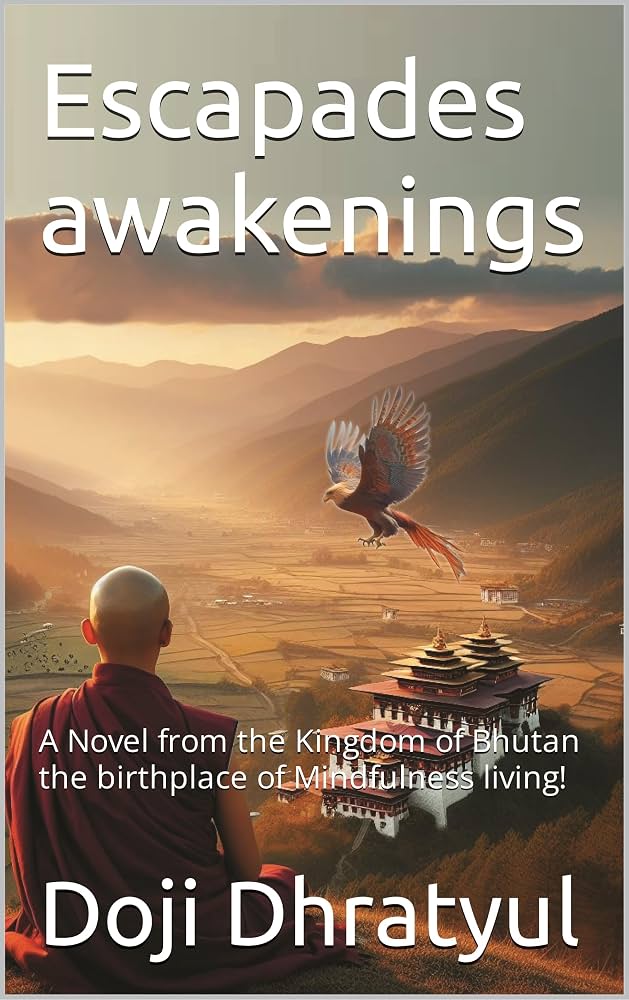
And yet I kept reading. That has to count for something.
Because underneath the clumsy writing, endless explanations and increasingly eyebrow-raising plot developments, there is actually a very good story! Almost against my will, I did become invested in the characters and genuinely cared what happened to them. I kept reading simply because I needed to know what happened next. And this book is almost 600 pages, mind you!
I just had a very strong urge to pick up a red pen and start editing.
The raw material is so good: several generations of women, enormous social change, ambition, exploitation, religion, power and the collision between traditional and modern Bhutan. I somehow kept seeing the amazing novel this could have been if someone had tightened the plot, trusted the reader a little more and moved a substantial portion of those italicised explanations somewhere else.
As it stands, the execution leaves a lot to be desired, but as a window into Bhutan, though, it is still a remarkable book.
The final stage of the zhugdrel ceremony, known as the Trashi Menlam, was a prayer specifically offered for the health, well-being and prosperity of the person and of those present on the occasion or for the success and good luck of the event in question.
Dhratyul gives us village life, religion, women and children’s position in society, changing traditions, government, democracy and the extraordinary speed with which Bhutan has changed. He also looks directly at uncomfortable things like sexual exploitation, poverty, corruption, and traditions that look considerably less charming than the image generally connected with his country.
So.
I really wish I could say that Escapades: Awakenings is a great novel. Unfortunately it is not.
I’d still recommend it, because buried inside a rather badly written book, there is an absolutely fascinating story.
Footnote exasperation aside, I am very happy that I chose it as my read for Bhutan.
But there would be other options, if you can’t stomach the footnotes …