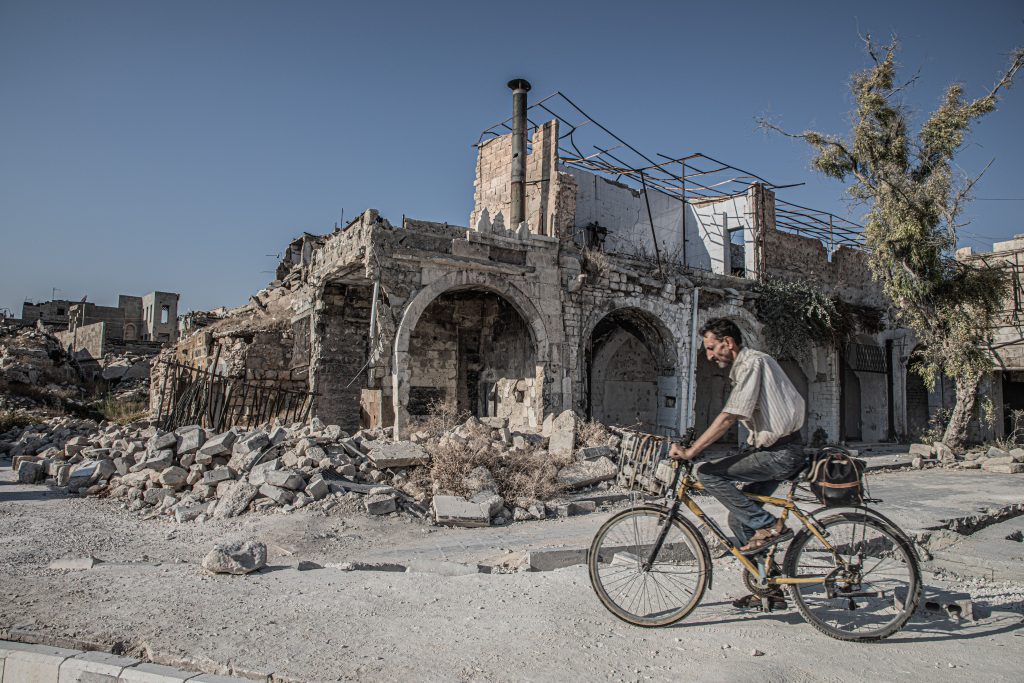
The images are painfully familiar: bombed-out cities, refugees crossing borders, protests, prisons, Assad, ISIS. And those things inevitably appear in Syrian literature too. It would be strange if they didn’t.
But books from Syria offer so much more.
There is Damascus before the war and Aleppo across decades of political change. There are storytellers and dissident writers, political prisoners and musicians. There is satire, dystopia and short fiction alongside memoir and oral history. Some books take us directly into the uprising and civil war, while others show the fear and repression that came long before 2011.
Here are my ten picks for Syria:
A list of books to read from Syria
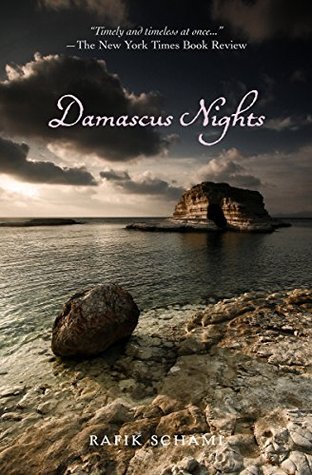
Damascus Nights
Author: Rafik Schami
First published: 1989
Original title: Erzähler der Nacht
Genre: Literary Fiction / Magical Realism / Short Stories
In Damascus in 1959, Salim is an elderly coachman with a gift: he is the city’s greatest storyteller. Then, one evening, he suddenly loses his voice. According to an old fairy tale, there is only one cure. He must receive seven unique gifts within three months. His seven friends decide that the gifts will be stories.
Over seven nights they gather to tell their tales. While the hairdresser, the teacher, the wife of the locksmith sip their tea and pass the water pipe, they swap stories about the magical and the mundane: about djinnis and princesses, about contemporary politics and the difficulties of bargaining in a New York department store. Creating a novel within stories that draws heavily on the Arabic oral storytelling tradition.
Schami was born in Damascus but has lived in Germany since the 1970s, and the novel was originally written in German. Still, its heart is firmly in the city where he grew up.
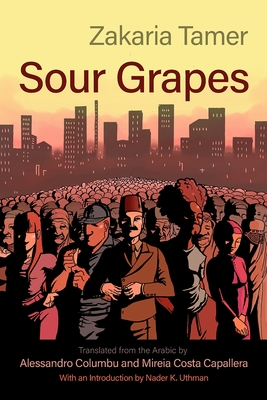
Sour Grapes
Author: Zakaria Tamer
First published: 2000
Original title: Al-Hisrim (الحصرم)
Genre: Short stories / Satire
Fifty-nine wry, satirical short stories take us into the fictional Syrian neighbourhood of al-Qaweyq, populated by convicts, officials, lovers, children and people simply trying to get through everyday life.
Inspired by the heroines of Arab mythology, the women of al-Qaweyq navigate the patriarchal community with brash confidence and dark humor while the younger generation of children inherit a bitter cynicism from their fathers. Everyday life under an oppressive regime is rarely entirely ordinary.
Evoking under-ripened and immature fruit, the collection’s title serves as a bittersweet metaphor for a world that possesses the seeds of change but is unprepared for the harvest. Zakaria Tamer is one of the Arab world’s most prominent and widely read writers, considered a master of the short story genre.
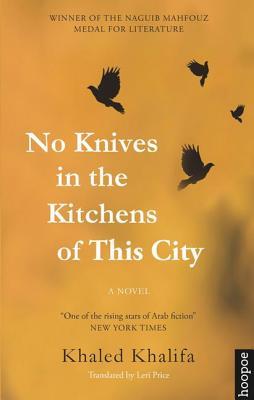
No Knives in the Kitchens of This City
Author: Khaled Khalifa
First published: 2013
Original title: La Sakakin fi Matabikh Hadhihi al-Madina (لا سكاكين في مطابخ هذه المدينة)
Genre: Literary Fiction / Family Saga
In the once beautiful city of Aleppo, one Syrian family collapses into tragedy and ruin.
Beginning around the Ba’athist coup of 1963 and stretching into the 2000s, Khaled Khalifa follows several generations through changing relationships, thwarted ambitions, sexuality, religion and the suffocating presence of the state. Sawsan moves between militias, the ruling party and religion in search of somewhere to belong, while those around her find their own ways of surviving.
Khalifa remained in Syria through most of the civil war and died in Damascus in 2023. This novel won the Naguib Mahfouz Medal for Literature and offers a way of understanding some of what came before 2011.
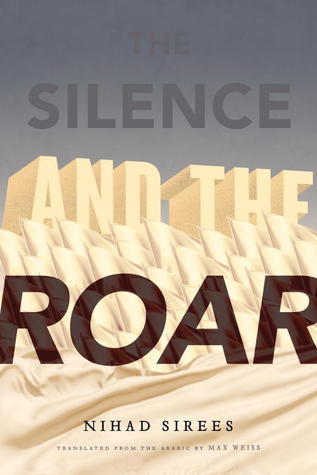
The Silence and the Roar
Author: Nihad Sirees
First published: 2004
Original title: Al-Samt wa al-Sakhab (الصمت والصخب)
Genre: Dystopian fiction / Political satire
It’s a national holiday. The streets are packed. Loudspeakers roar. Everyone is expected to celebrate twenty years of their glorious Leader. Fathi Sheen would rather not.
He is an author banned from publishing because he refuses to write propaganda for the ruling government. Desperate to get away from the noise and the zombie-like masses, Fathi leaves his house to visit his mother and his girlfriend, but en route stops to help a student who is being beaten by the police. Fathi’s iD papers are confiscated and he is told to report to the police station before night falls.
When Fathi turns himself in, he is led from one department to another in an ever-widening bureaucratic labyrinth. His only weapon against the irrationality of the government employees is his sense of irony.
At just around 160 pages, this is one of the shortest novels on the list. And very possibly one of the strangest, tinged with a Kafkaesque sense of the absurd. Both of which are in fact instant attractions for this particular bookworm.
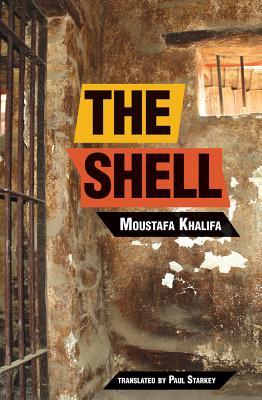
The Shell: Memoirs of a Hidden Observer
Author: Mustafa Khalifa
First published: 2008
Original title: Al-Qawqa’a: Yawmiyyat Mutalassis (القوقعة: يوميات متلصص)
Genre: Autobiographical novel / prison literature
A young Syrian returns home after studying film in France and is arrested at Damascus airport. He has no idea why.
Accused of belonging to the Muslim Brotherhood despite being an atheist from a Christian family, he disappears into Syria’s prison system without trial. Inside, torture and arbitrary violence become routine. His atheism also isolates him from many of his fellow prisoners, and he retreats into what he calls his “shell”, silently watching the world around him.
Mustafa Khalifa himself spent years imprisoned by the Syrian regime, and the novel draws heavily on those experiences. That makes this one of the grimmest books here, but also an important window into the prison system and political repression of the Assad era long before the 2011 uprising.
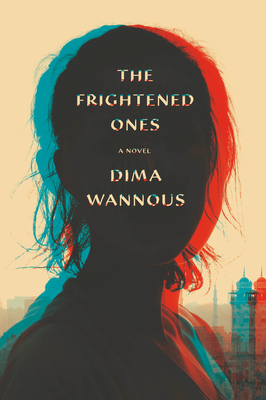
The Frightened Ones
Author: Dima Wannous
First published: 2017
Original title: Al-Kha’ifun (الخائفون)
Genre: Literary fiction / Psychological fiction
Suleima meets Naseem in a psychiatrist’s waiting room in Damascus. Both belong to a generation that has grown up knowing fear almost as a normal state of being.
Then Naseem leaves Syria and sends Suleima the unfinished manuscript of a novel. As she reads about its central character, she begins to recognise unsettling similarities between the fictional woman and herself.
Dima Wannous is interested not only in what authoritarianism physically does to people, but in what decades of surveillance and repression do inside their heads. Fear seeps into relationships, bodies and identities, and the boundary between Suleima’s life and Naseem’s manuscript begins to blur.
This is Syria seen not primarily through battles or political events, but through the psychological consequences of living for years in a society where fear has become ordinary.
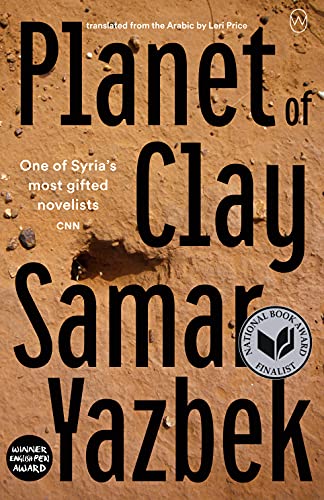
Planet of Clay
Author: Samar Yazbek
First published: 2017
Original title: Al-Masha’a (المشّاءة)
Genre: Literary Fiction / War Fiction
Rima is a young girl from Damascus who doesn’t speak and has an uncontrollable urge to walk. For much of her childhood, the people who love her keep her physically tethered to stop her wandering away.
Then Syria begins to collapse around her, and Rima and her mother are caught at a military checkpoint. She is pulled into the violence of the civil war and eventually finds herself trapped in a rebel-held area outside Damascus. She makes sense of what she sees through drawing, stories and the books she loves, particularly The Little Prince and Alice in Wonderland.
Samar Yazbek uses Rima’s unusual perspective to make an already surreal war stranger still, moving between horrific reality and the imaginary worlds in which Rima takes refuge.
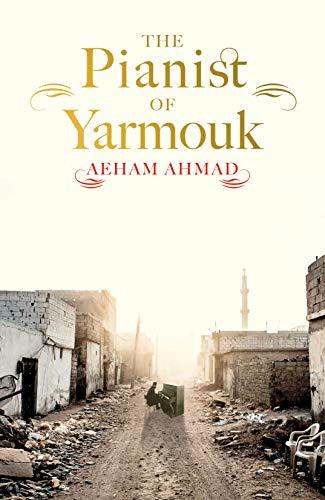
The Pianist of Yarmouk
Author: Aeham Ahmad
First published: 2017
Original title: Und die Vögel werden singen: Ich, der Pianist aus den Trümmern
Genre: Non Fiction / Memoir
In photographs that travelled around the world, Aeham Ahmad sits at a piano amid the ruins of Yarmouk. This is the story behind those photographs.
Ahmad was born in Damascus into a Palestinian family and grew up in Yarmouk, the Palestinian refugee camp that had gradually become a neighbourhood of the city. Encouraged by his blind father, an instrument maker, he began playing piano as a child and later studied music.
As Yarmouk was cut off and its residents faced bombardment and starvation, Ahmad wheeled his piano into the streets and played for his neighbours. His memoir takes us from childhood in Syria through the destruction of Yarmouk and eventually his dangerous journey out of the country.
This is a different perspective from the other books on this list: that of the Palestinian community that had already experienced displacement once before war forced many to flee again.
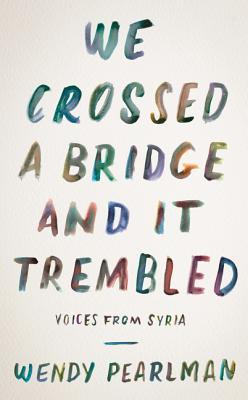
We Crossed a Bridge and It Trembled
Author: Wendy Pearlman
First published: 2017
Original title: We Crossed a Bridge and It Trembled: Voices from Syria
Genre: Non Fiction / Journalism / Oral History
Full disclosure: Wendy Pearlman is American, not Syrian. But all the voices in the book are Syrian.
Over four years, Pearlman interviewed hundreds of displaced Syrians across the Middle East and Europe. She then arranged their words into an oral history that moves from life under authoritarian rule through the first hopes of the 2011 uprising, the crackdown, militarisation, war and finally flight.
Some testimonies run for pages; others consist of only a handful of sentences. Together they create something very different from a conventional history of the Syrian war. There is no single protagonist and no narrator explaining what Syria means. Instead, people who lived through these events tell us themselves.
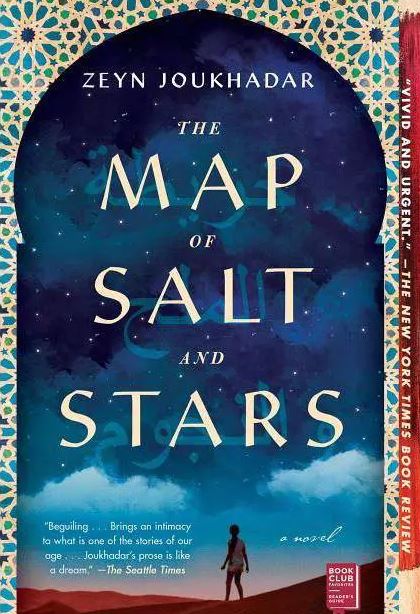
The Map of Salt and Stars
Author: Zeyn Joukhadar
First published: 2018
Original title: The Map of Salt and Stars
Genre: Historical fiction / contemporary fiction
Two girls set out on journeys across the same part of the world, more than eight hundred years apart.
In 2011, twelve-year-old Nour moves with her mother and sisters from New York to Homs, where their family hopes to build a new life after the death of Nour’s father. But protests and shelling soon force them to flee Syria.
Running alongside Nour’s story is the tale she tells herself for comfort: the twelfth-century adventure of Rawiya, a girl who disguises herself as a boy and becomes apprentice to the famous mapmaker al-Idrisi.
As Nour’s family travels through the Middle East and North Africa seeking safety, the two journeys begin to echo one another across centuries.
Joukhadar is Syrian-American and the novel was written in English, making this one of the more diaspora-oriented books on the list. But its combination of contemporary Syria, medieval history, maps, migration and adventure brings something quite different to the selection.
Join me, and read a book from Syria
There is a storyteller entertaining his friends in Damascus. There are families living through decades of change in Aleppo, neighbourhood characters making jokes under an oppressive regime, writers refusing to praise dictators, and children growing up with fears they barely know how to name.
The books on this list range from the magical and absurd to the brutally real. Some were written inside Syria, some in exile, and some by writers who grew up between Syrian and other cultures. One collects hundreds of voices rather than telling a single story.
Together, they don’t offer one version of Syria.
That is rather the point.
Which one would you pick up first? Did you read any of them already?