It is impossible to predict what might happen in a world where you don’t know the rules
(This review contains spoilers)
I have read a lot of Dystopia. The interest on my part started with The Hunger Games series, when it was first published, moving on to an extensive list of YA fiction from a “how to cure your Hunger Games hangover”-list I found on Pinterest. And then later I devoured all of the “grown-up” classic dystopias of George Orwell, Aldous Huxley and the like. And I’ve also much enjoyed some of the newer climate change dystopias like The Parable of the Sower. So I do consider myself fairly well versed in this genre, and despite that I will tell you right now, that I have never read anything like I who have never known men.
This story begins in a truly horrifying setting: 40 women imprisoned in a cage underground, guarded by men who never speak or explain why they are there. The women’s only company is each other. They are fed and clothed sparingly, and are not allowed to touch.
The women remember aspects of life before, but not how they came to be in the cage, and they only vaguely recall the violence they were subjected to at the beginning of their captivity. The guards use this visceral memory to control the women, and no longer need to use the whip.
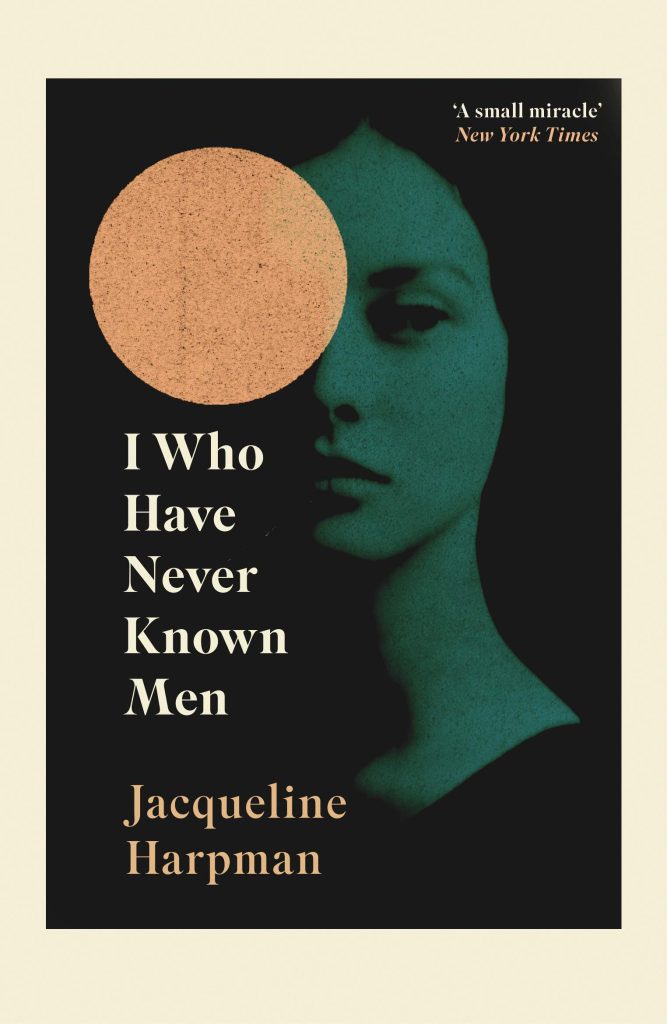
The protagonist of the book was a small child when they were imprisoned, and she is the only one who has no memory of life outside captivity. And she is feeling rebellious, so she starts counting her heartbeats to understand the passage of time, and decides to stare down a young guard, to distinguish herself from the others and because she has nothing else to do.
When one day a siren blares, the guards suddenly vanish, leaving the cage unlocked, and the forty women emerge into a desolate, post-apocalyptic landscape. Maybe this is not earth, they wonder, but the answer is never found.
In fact no answers to anything are ever found. What follows is not a story of revolution or rebuilding, or indeed any sort of explanation of how the current affairs came to be.
Instead it is story of wandering. A group of women with no clear goal, no societal rules, gradually losing all hope of returning to whatever came before. It’s a philosophical exploration of the meaning of life, when there is no future.
I was forced to acknowledge too late, much too late, that I too had loved, that I was capable of suffering, and that I was human after all.
And this is not a spoiler, because the book specifically tells you from page one that it will not have a happy ending. Yet, I personally continued to hope and believe that everything would be explained. Lo and behold, it will not. No explanation for the imprisonment. No backstory for the protagonist. The first chapter does not lie to you. This book will give you a lot of questions, but not a single answer.
Harpman’s story is startlingly bleak and quiet. The tension doesn’t come from battles or rebellion like most dystopias, but from the slow unravelling of the characters’ psyches as they confront their isolation and the futility of their existence. How do you find a purpose where there is none?
This book was interesting enough for me to do a deep dive on the author. Jacqueline Harpman was born in Etterbeek, Belgium, in 1929. Being half Jewish, she fled to Casablanca with her family during WWII, returning to Belgium after the war. She trained to be a doctor, but had to give it up on account of contracting Tuberculosis. She later became a psychoanalyst, and all of her work reflects a deep psychological complexity. She wrote in French, often exploring themes of identity and alienation.
I have understood nothing about the world in which I live.
I have criss-crossed it in every direction but I haven’t discovered its boundaries.
I who have never known men is the first of her books available in English translation. It was marketed as “feminist dystopia” and I went into this thinking it would have a starkly feminist angle of the caged women suffering under some sort of patriarchal rule. But that turned out not to be the case at all, as the protagonist comes to discover that the men in this enigmatic society suffered an equally grim fate.
I came away from this book with more questions than answers, but perhaps that’s the point. In a world without rules, without history, and without a future, what’s left?
This is not an easy book to categorize or even to recommend, though I personally did find it strangely compelling in its own very unique way. It’s bleak, unsettling, and disturbing and it doesn’t really offer the catharsis or satisfaction that you might expect from dystopian fiction. But if you are willing to embrace its ambiguity, I Who Have Never Known Men is a moving exploration of what it means to exist when all the rules have been stripped away. And it makes you ponder the meaning of life itself.