
Sons of the earth-crack
I knew the broad outlines of Iraq’s recent history before reaching for The President’s Gardens.
Saddam Hussein. The Iran-Iraq War. Kuwait. The Gulf War. Sanctions. The American invasion. They are all events I remember from news broadcasts, ureduced to politicians, armies, maps and casualty numbers.
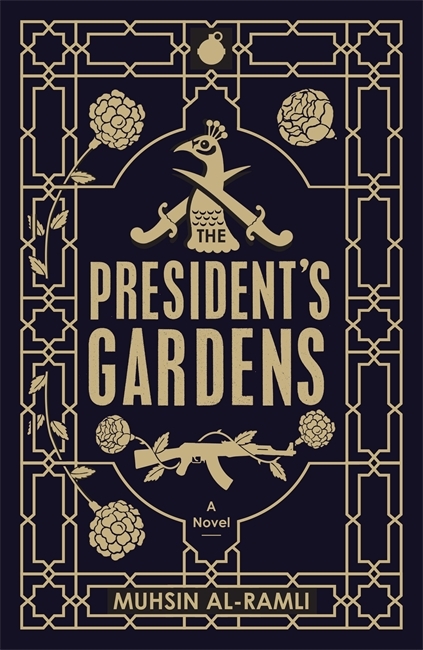
Muhsin Al-Ramli brings that history down to the level of three boys growing up in an Iraqi village.
And I very much enjoyed it.
In a land without bananas, the village awoke to nine banana crates, each containing the severed head of one of its sons. Along with each head was an ID card to identify the victim since some of the faces were completely disfigured, either by torture before the beheading or by something similar after the slaughter.
It opens with nine banana crates left beside the road outside a village where bananas do not grow. Inside each is the severed head of one of the village’s sons. One belongs to Ibrahim the Fated.
From there, we go backwards.
Ibrahim the fated, Abdullah Kafka and Tariq the Befuddled are born in the same village in 1959 and grow up as inseparable friends despite their very different families. There are marriages, children, feuds, gossip and complicated relationships. But as they grow older, the outside world begins to dictate the course of their lives.
The Iran-Iraq War sends Abdullah into years of Iranian captivity. Ibrahim goes to war and later loses a foot during the Gulf War. Tariq manages to escape much of what befalls his friends and gradually accumulates influence and power.
Around them come Kuwait, rebellion, repression, sanctions and eventually the American invasion.
Yet The President’s Gardens never felt like a novel designed to walk you through Iraqi history. You experience the whole from the ground, through people who are mostly just trying to marry the people they love, feed their families, raise their children and survive whatever their country throws at them next.
The President himself is never named, but Saddam Hussein’s presence hangs over the novel. Ibrahim eventually finds himself working in one of the President’s magnificent gardens, where beauty, luxury and unimaginable cruelty exist side by side. I knew enough about Saddam’s regime to know where some of this was heading, but that didn’t make it any less horrifying.
This is a very brutal book in places. There is war, torture, imprisonment, execution and death. But Al-Ramli gives his characters enough life that the novel never becomes an endless procession of suffering. There is sex and love, humour and village gossip, petty jealousies and ridiculous arguments. People behave badly. They make jokes. They fall in love with the wrong people. They carry grudges for decades.
The Iraq of Al-Ramli remains a place where people live, rather than merely a place where history happens.
He had other abilities that the women would whisper about. Some of the reports originated with Suhail’s blind wife, who used to think all men had what hers had: a member as long as her forearm.
Al-Ramli himself was born in northern Iraq in 1967 and lived through much of the history he writes about. His brother, writer and poet Hassan Mutlak, was executed by Saddam Hussein’s regime in 1990 after taking part in an attempted coup. Al-Ramli later left Iraq and has lived in Madrid since the 1990s. Knowing that background makes some of the novel’s horrors feel even more present.
It is a sprawling story about three friends whose lives are repeatedly knocked off course by forces far beyond their control. And because I very much cared about those three men, decades of Iraqi history suddenly became something far more immediate than the succession of wars and dictators I knew from the news.
The pacing is a little strange at times, and some of the side plots take up a lot of space, where I was yearning to get back to the main characters, but all in all I picked The President’s Gardens because I wanted a book that would take me inside Iraq, and hoped it would give me characters to care about. And it did exactly that.
I’ll note it down as one of my favourite reads of this journey so far.
But if you want something else, here are some other options for Iraq.
And a warning: The President’s Gardens has a sequel called Daughter of the Tigris, and you will want to read it immediately after you finish this one.
I am probably not up for this book, so I will choose another one from your list. Meanwhile, I finally finished a book I’ve had checked out from the library for a while: Between Two Rivers: Ancient Mesopotamia and the Birth of History (2025) by Moudhy Al-Rashid. The author arranged the book around some of her favorite artifacts found in a building in Ur that appeared to house an ancient museum.
It sounds fun, and I do like how the author likes to make alien-seeming traditions relatable, but she bounces all around the history in a style that reminds me of stream-of-consciousness, not a favorite for me. I didn’t get through much in each sitting.
But there was a lot of fascinating information. Here are my favorite things I learned:
‘A stepped pyramid [ziggurat] soars almost 100 feet above the sprawling ruins of the city of Ur, which once sat at the mouth of the Euphrates River in the sandy expanse of what is now southern Iraq. Ur was continuously occupied for almost 3.5 millennia. The meandering waters of the river changed course millennia ago, leaving the inhabitants of Ur with no choice but to abandon the desiccated site.’ And thus, it has not been built over and is accessible for excavation. It’s also further from the Persian Gulf than it once was.
It’s fun to read about cultures that have different basic natural resources than we’re used to, like Ancient Egypt’s papyrus. Mesopotamia had high quality clay which ended up being used for writing. Clay is also what they thought the gods had built man from.
Bricks were made with clay, chopped straw, sometimes animal dung, and water. This was put in standard-sized molds, then laid out to dry in the sun for 2+ weeks (or sometimes baked), ideally in spring or summer. Strong at first, they would fracture as the straw decayed. Mortar was also clay + straw + water, except ‘in important construction works like a ziggurat, bitumen was used’ along with reeds.
Bitumen is ‘a natural petroleum tar … so viscous that, unless heated or diluted in specific ways, it is immobile; … it cannot flow on its own…. Black and thick, it bubbled up from beneath the fertile plains of ancient Mesopotamia, where the inhabitants of Ur and other nearby cities used it as an adhesive to make things like boats, baskets, and buildings’ and to mend things like drainpipes, bowls, and statues.
The writing implement came from the reed. One end was sharpened to trace pictograms; the other was left naturally round and pressed ‘into the clay at various angles to represent numbers.’
Reeds were also used to line waterways and in building. The marginalized Marsh Arabs of today still live at the conjunction of the Tigris and Euphrates and they build their houses similarly, using reeds ‘bundled and interlocked into thick columns, each as wide as 2 people standing side by side. Several of these columns are then bent into arches to form the backbone of these structures, and smaller reeds are tightly woven across these to form the roof and walls, with small perforations to let light through.
Cuneiform evolved to have both logograms (characters that stand for words, like English’s ampersand) and syllabograms (phonetic representations of syllables). For example, the sign for ‘deity’ precedes divine names and the sign for ‘place’ follows city names. (This sort of thing would be helpful in some books to know which names were for people, which for pets, which for robots, etc.) And it’s a mixed system with all the logograms coming from Sumerian even when used to write the unrelated Akkadian language (like Japanese sometimes incorporates Chinese kanji alongside phonetic and syllabic components). They could have used just the syllabograms like they did when writing the Semitic language Eblaite (in what is now Syria)—they even evolved it into an alphabet ‘in the nearby city of Ugarit.’ But ‘Sumarian’s antiquity and prestige’ led them to keep some of it for Akkadian. (This sounds like how English speakers like to use the dead language of Latin for new words.)
Cuneiform started as tracings in clay and evolved into the wedge shapes, and it was started by accountants. The first accounting tools were little clay tokens (throughout the ancient Middle East from 7500 BC) such as tiny jugs to represent oil, different tiny jugs to represent beer, or (later, I presume) different geometric shapes, perhaps with extra markings, to represent different goods. These were ‘sometimes stored in spherical clay envelopes impressed with markings on the outside to reflect their contents’ and sometimes imprinted with a seal. These evolved into 2D signs incised into pillow-shaped clay tablets, with tracings such as a bowl for food or rations, genitalia for the sexes of the workers, and a jug for milk or beer, along with dots to indicate quantity.
Most of what survives of Sumerian literature actually comes from schools. Students copied literature to perfect their writing.
Seals are AA-battery-sized stone cylinders ‘carved with imagery and, later, minute inscriptions that said something bout their owner, like an ancient social media avatar.’ They could be rolled onto clay to authenticate a document, like modern letterhead. The stone they were carved from was sometimes semi-precious. I actually got to see a bunch of seals in a museum earlier this year.
From your list I chose Frankenstein in Baghdad. This is a book with a lot of characters, and there is a lovely list of these with useful descriptions at the front. But really, there are only six main characters.
There’s Hadi the junk dealer and storyteller who is associated with his friend the tea shop owner and neighbors across the way who are both nosy and helpful. He embellishes his stories and so is also called the liar.
There’s Elishva, the elderly Christian widow, also called a madwoman because she is always talking your ear off about her long-missing son. She also has two daughters who have emigrated, her priest, the same neighbors who watch Hadi (she and Hadi share an adjoining wall), a picture of St. George who talks with her most evenings, and a cat.
There’s Hasib, a hotel guard, who dies from a suicide car bomb, protecting his workplace, and his six post-death assistants (more on them in a minute).
There’s Faraj, a realtor, who wants to buy Elishva’s house and a neighbor’s dying hotel.
There’s Mahmoud, a reporter whose workload keeps increasing as his boss disappears for longer and longer periods, plus his co-workers and his boss’s driver and probable lover.
And there’s Majid, the ambitious head of a mysterious government department and his underlings, including astrologists who help him predict catastrophes in time to evade or even stop them and who help him investigate crime, though the powers that be don’t always listen.
You don’t have to wait until the end of the book to find out how their stories intersect like in some books. They are intersecting the whole time. Hadi the junk dealer has also picked up body parts and decided to sew them together into a full body (aka Whatsitsname) so these dead will be buried properly, treated with the respect they deserve. Hotel guard Hasib becomes a ghost with no body; he finds Whatsitsname, a body with no soul, and enters it. Widow Elishva sees Whatsitsname and decides he is her son who has finally returned and takes care of him. Whatsitsname leaves her for days at a time but always returns. It’s during these disappearances that mysterious murders occur and a fleeing man is spotted who can’t be killed or even made to bleed with gunshots. Reporter Mahmoud wants Hadi to tell him about Whatsitsname so he can write a story, and government guy Majid sees that story and wants Mahmoud to tell him what he knows of Whatsitsname so he can be stopped.
Gradually it comes out that Whatsitsname is avenging the deaths of all the people who have become a part of him. He spoke out (recording his story on tape) because he didn’t want people to think he was a bad guy, just killing people at random. He also didn’t want glory. He just wants to set an example of vengeance for the innocent who have no protection, since no one else is holding people accountable. But his story never reaches the public.
Whatsitsname’s assistants are the only people not directly listed in the cast of characters at the front: the Magician, the Sophist, the Enemy (really a spy from the enemy), the young madman (clearly Hadi), the old madman, and the oldest madman. (Maybe I’m supposed to recognize more of them.) He ends up collecting lots of followers who, just as the rest of the public does, see him in different ways. Is he the first true Iraqi citizen, being a mix of people from diverse ethnicities, tribes, races, and social classes? An angel of death, bringing on the coming of the savior that all the world’s religions have predicted? The savior himself? Tragically, these different sects end up fighting each other.
Another problem is that if Whatsitsname takes too long to avenge the person behind one of his body parts, it starts to fall off. Similarly, when he does avenge someone, that part of his body soon falls off. His followers find replacement parts for him. ‘My list of people to seek revenge on grew longer as my old body parts fell off and my assistants added parts from my new victims, until one night I realized that under these circumstances I would face an open-ended list of targets that would never end. … I started hoping that the killing in the streets would stop, cutting off my supply of victims and allowing me to melt away.’ But no. This is 2005 Baghdad where there are regular suicide bombings. At this point, there is speculation that fear alone (of the other sides) is leading to a lot of the violence. For example, in one scene, some people, fearing a suicide bomber, jump off a bridge, to their deaths. It’s also a situation where it’s hard to tell who to believe. Of course your son did not come back from the Iran-Iraq war after all these years—except people often returned after, for example, being prisoners of war; the unlikely sometimes happened. And Whatsitsname also comes to find that he values his own life enough to make bad decisions.
In the end (and from the prologue), there was closure for most of the characters, which I appreciate, though I still had a few questions. And, being set in just one year, and mostly in just one neighborhood, the book leaves me curious to read more books from this country, which was really not something I expected.