
I came to Hungary completely blind. I’ve never been there in person, and before this project, I couldn’t have named a single Hungarian author. Only had some vague associations to thermal baths, paprika, and a notoriously difficult language.
But once I started digging for books translated from Hungarian, I found disgraced barons wandering back to nowhere towns, elderly couples tasting freedom for the first time in decades, absurd political regimes, and lives quietly falling apart. From haunted doorways to historical sieges to a murder in 1930s Budapest, this list turned out to be one of the strangest so far.
A list of books to read from
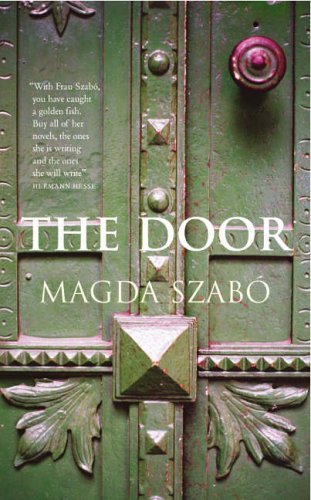
The Door
Author: Magda Szabó
First published: 1987
Original title: Az ajtó
Genre: Literary Fiction / Psychological Drama
A busy young writer struggling to cope with domestic chores, hires a housekeeper recommended by a friend. The housekeeper’s reputation is one built on dependable efficiency, though she is something of an oddity. Stubborn, foul-mouthed and with a flagrant disregard for her employer’s opinions she may even be crazy. She allows no-one to set foot inside her house; she masks herself with a veil and is equally guarded about her personal life. And yet Emerence is revered as much as she is feared.
As the story progresses her energy and passion to help becomes clear, extinguishing any doubts arising out of her bizarre behaviour. A stylishly told tale which recounts a strange relationship built up over 20 years between a writer and her housekeeper. After an unpromising and caustic start benign feelings develop and ultimately the writer benefits from what becomes an inseparable relationship. Simultaneously we learn Emerence’s tragic past which is revealed in snapshots throughout the book.
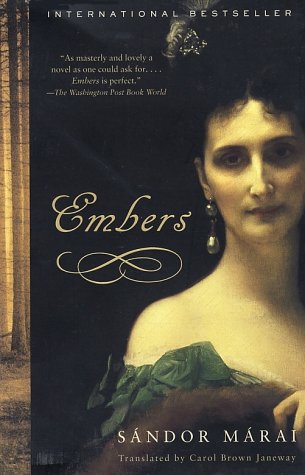
Embers
Author: Sándor Márai
First published: 1942
Original title: A gyertyák csonkig égnek
Genre: Historical Fiction / Psychological Drama
In a secluded woodland castle an old General prepares to receive a rare visitor, a man who was once his closest friend but who he has not seen in forty-one years. Over the ensuing hours host and guest will fight a duel of words and silences, accusations and evasions. They will exhume the memory of their friendship and that of the General’s beautiful, long-dead wife. And they will return to the time the three of them last sat together following a hunt in the nearby forest. A hunt in which no game was taken but during which something was lost forever.
Originally published in 1942 and rediscovered to international acclaim, this taut and exquisitely structured novel by the Hungarian master Sandor Marai conjures the melancholy glamour of a decaying empire and the disillusioned wisdom of its last heirs. A classic of modern European literature.
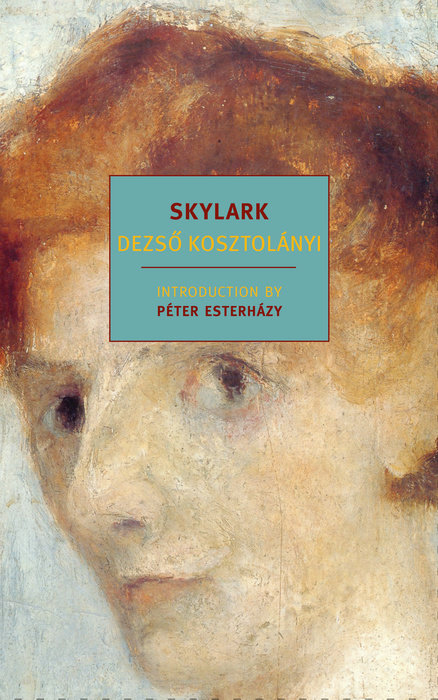
Skylark
Author: Dezső Kosztolányi
First published: 1924
Original title: Pacsirta
Genre: Classic Fiction / Tragicomedy
It’s around 1900 in the sleepy Hungarian town of Sárszeg. Mother and Father Vajkay live a quiet, joyless life, devoted entirely to their adult daughter, Skylark—unmarried, unremarkable, and the center of their small world. When Skylark leaves for a week, her absence unexpectedly opens the door to pleasure: dinners out, old friends, even a wild night at the Panther Club.
But with her return, reality sets back in. Was that glimpse of freedom just a fluke—or a revelation? With gentle irony and deep emotional insight, Kosztolányi turns a seemingly small story into something quietly profound.

Under the frog
Author: Tibor Fischer
First published: 1992
Genre: Satirical Fiction / Historical Fiction
Shortlisted for the Booker Prize, Under the Frog follows the adventures of two young Hungarian basketball players through the turbulent years between the end of World War II and the anti-Soviet uprising of 1956. In this spirited indictment of totalitarianism, the two improbable heroes, Pataki and Gyuri, travel the length and breadth of Hungary in an epic quest for food, lodging, and female companionship.
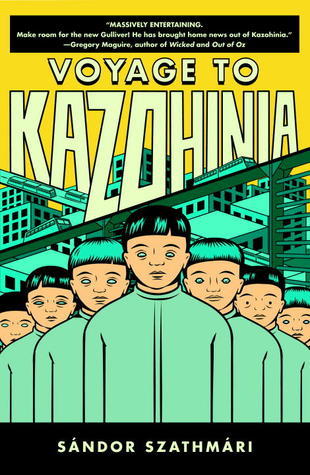
Voyage to Kazohinia
Author: Sándor Szathmári
First published: 1941
Original title: Kazohinia
Genre: Dystopian / Satire
This classic dystopian satire has been compared to the likes of Brave New World, Gulliver’s Travels and The Wizard of Oz. Voyage to Kazohinia is a tour de force of twentieth-century literature.
Sándor Szathmári’s novel chronicles the travels of a modern Gulliver on the eve of World War II. A shipwrecked English ship’s surgeon finds himself on an unknown island whose inhabitants, the Hins, live a technologically advanced existence without emotions, desires, arts, money, or politics. Soon unhappy amid this bleak perfection, Gulliver asks to be admitted to the closed settlement of the Behins, beings with souls and atavistic human traits. He has seen nothing yet. A massively entertaining mix of satire and science fiction, Voyage to Kazohinia has seen half a dozen editions in Hungary in decades since its original publication and remains the country’s most popular cult classic.
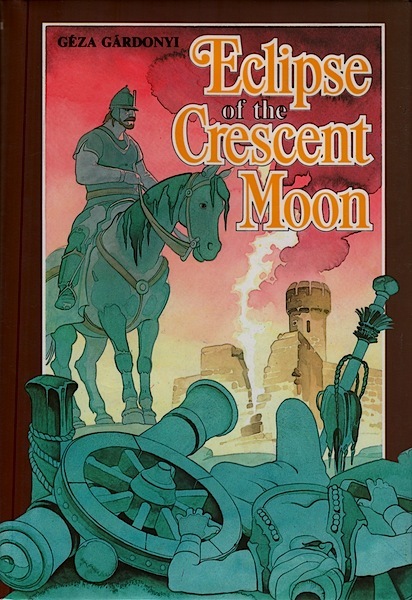
Eclipse of the crescent moon
Author: Géza Gárdonyi
First published: 1899
Original title: Egri csillagok
Genre: Historical Adventure / National Classic
The siege of Eger was an astonishing event. A small Hungarian Garrison commanded by István Dobó successfully resisted a huge Turkish army for nearly six weeks and forged it to retreat in disgrace. Dobó became a celebrated hero. But little is known of his explosives expert, Gergely Bornemissza, whose ingenious devices demoralized the Turks. It is his story that Géza Gárdonyi tells in Eclipse of the Crescent Moon, an exciting tale of chivalry and love, adventures and disasters, heroes and villains, culminating in the siege itself. Gárdonyi’s story, a convincing blend of history and fiction, has become a Hungarian literary classic and a firm favourite with adults and children alike.
Baron Wenckheim’s Homecoming
Author: László Krasznahorkai
First published: 2016
Original title: Báró Wenckheim hazatér
Genre: Literary Fiction / Philosophical Absurdism
Set in contemporary times, Baron Wenckheim’s Homecoming tells the story of a Prince Myshkin–like figure, Baron Bela Wenckheim, who decides to return at the end of his life to the provincial Hungarian town of his birth. Having escaped from his many casino debts in Buenos Aires, where he was living in exile, he wishes to be reunited with his high school sweetheart Marika.
What follows is an endless storm of gossip, con men, and local politicians, vividly evoking the small town’s alternately drab and absurd existence. All along, the Professor, a world-famous natural scientist who studies mosses and inhabits a bizarre Zen-like shack in a desolate area outside of town, offers long rants and disquisitions on his own attempts to immunize himself from thought. Spectacular actions are staged, death and the abyss loom, until finally doom is brought down on the unsuspecting residents of the town.

Pixel
Author: Krisztina Tóth
First published: 2011
Original title: Pixel
Genre: Contemporary Fiction / Linked Stories
Like stars in the sky, pixels may seem like tiny, individual points. But, when viewed from a distance, they can create elaborate images. Each pixel contributes to this array, but no individual point can create the whole. The thirty stories that comprise Krisztina Tóth’s book similarly produce an interconnected web.
While each tale of love, loss, and failed self-determination narrates the sensuousness of an individual’s life, together, the thirty stories tell a more complicated tale of relationships. Circumstances that appear unrelated may converge in harmony or in heartbreak, just as the events that loom largest may fail to produce a longed-for outcome. These threads often determine the course of lives in unpredictable ways, sometimes comic, sometimes tragic, but rarely in the ways we originally anticipated.
Budapest Noir
Author: Vilmos Kondor
First published: 2008
Original title: Budapest noir
Genre: Historical Crime Fiction
The passing of the Hungarian prime minister before he could realize his dream of a fascist state has little effect on crime reporter Zsigmond Gordon. Life – and death – go on in the bustling old city, and a late-night tip soon leads him to a crime scene where a young woman lies dead, a Jewish prayer book in her purse. Disturbed by the bizarre circumstances: the corpse of a beautiful, well-groomed, religious victim abandoned in one of Budapest’s seedier neighborhoods, Gordon is determined to unravel the mystery of her demise, especially after her shocking identity is revealed.
The investigation will lead him deep into the city’s dark underbelly, a shadow world of pornographers, crime syndicates, and Communist cells, and to the highest echelons of power, where one of Hungary’s most influential executives plans to make an economic killing through his strong political ties to Germany’s leaders…if he can somehow keep secret the fact that he was, at one time, Jewish.
A gripping and evocative thriller, brimming with suspense and breathtaking political intrigue, Vilmos Kondor’s Budapest Noir is a richly atmospheric tale of murder and betrayal from a remarkable new voice in noir detective fiction.
Tranquility
Author: Attila Bartis
First published: 2001
Original title: A nyugalom
Genre: Literary Fiction / Psychological / Urban
Tranquility is a living seismograph of the internal quakes and ruptures of a mother and son trapped within an Oedipal nightmare amidst the suffocating totalitarian embrace of Communist Hungary. Andor Weér, a thirty-six-year-old writer, lives in a cramped apartment with his shut-in mother, Rebeka, who was once among the most celebrated stage actresses in Budapest. Unable to withstand her maniacal tyranny but afraid to leave her alone, their bitter interdependence spirals into a Sartrian hell of hatred, lies, and appeasement. Then Andor meets the beautiful and nurturing Eszter, a woman who seems to have no past, and they fall wildly in love at first sight. With a fulfilling life seemingly within reach for the first time, Andor decides that he is ready to bring Eszter home to meet Mother.
Though Bartis’s characters are unrepentantly neurotic and dressed in the blackest humor, his empathy for them is profound. A political farce of the highest ironic order, concluding that “freedom is a condition unsuitable for humans,” Tranquility is ultimately, at its splanchnic core, a complex psychodrama turned inside out, revealing with visceral splendor the grotesque notion that there’s nothing funnier than unhappiness.
Join me, and read a book from Hungary
If (like me) you’ve never read Hungarian literature before, any book from this list could be a place to start. Let me know if any of these have caught your eye, or if you’ve read something else from Hungary you think I should try!