I killed Emerence
I do have other suggestions for Hungary, but really you should just read this one.
This region of my reading journey is shaping up to include some of the most unforgettable females, I have ever encountered. Emerence for sure will join Jarka and Janina in that special place in my heart, where literary characters live forever.
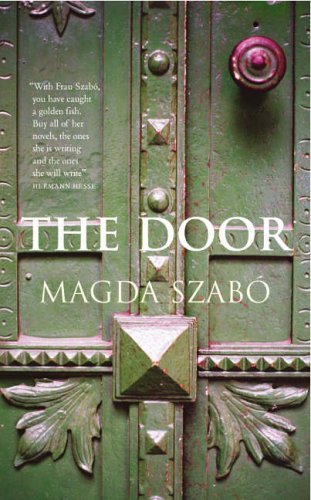
The premise of Magda Szabo’s The Door is this: a married, childless writer in mid-20th-century Hungary, (whose life and experiences closely parallels events in Szabó’s own), hires an elderly woman named Emerence to take care of the domestic work, so she herself can focus on her writing career.
Or rather, Emerence is not exactly someone you hire. She’s the type of person who scrutinizes you and decides, in due course, whether you are suitable for her to work for. Because Emerence is no ordinary housekeeper. She’s a force of nature. Feared and respected in equal measure in this small town, she knows everyone’s business and keeps everyone at arm’s length. She almost inhumanely strong, works relentlessly and fiercely guards her private life behind the literal and symbolic barrier of her front door, which no one is allowed to cross.
The narrator, a cultured intellectual, is absorbed in her literary career, and very soon finds herself hopelessly dependent on Emerence’s help. Emerence herself is blunt, illiterate, fiercely independent and completely unimpressed by the writer’s public acclaim.
The whole story revolves around the inevitable clashes between these two very different women, as their relationship evolves from a business arrangement into something far more intense and complicated.
We learn very little about the narrator’s husband, and his seemingly grave illnesses. A large part of the story is taken up by Emerence’s passionate attachment to a dog, who is found abandoned by the writer and her husband on Christmas Eve.
Once again her face changed. She was like someone standing in strong sunlight on a mountain top, looking back down the valley from which she had emerged and trembling with the memory still in her bones of the length and nature of the road she had travelled, the glaciers and forded rivers, the weariness and danger, and conscious of how far she still had to go.
And we take part in the writer’s growing obsession with finding out the details of Emerence’s past. As their bond deepens, we are gradually treated to small glimpses of Emerence’s life and we begin to understand the deep emotional scars that define her. A lifetime shaped by both personal trauma and the upheavals of the 20th century, war, occupation and shifting regimes. I honestly did not expect to learn so much about Hungarian history from this novel as I did.
You’re never quite sure whether to revere Emerence or be deadly afraid of her, but just when I thought I had it figured out – that this would be one of those novels where the servant goes crazy and takes over the narrators life, the story veered off in a completely different direction. The last third of the book left me reeling. I will not spoil the ending here but let’s just say it took a turn I definitely wasn’t ready for!
Emerence replied that she knew the peasant mentality, her own family were peasants. They didn’t care a straw who bought their eggs and their cream so long as it made them rich. The worker would fight for his rights only until he became the boss. She wasn’t interested in the proletarian masses (she didn’t use the word, but she described the thing), and above all she hated the idle, lying gentry. Priests were liars; doctors ignorant and money-grabbing; lawyers didn’t care who they represented, victim or criminal; engineers calculated in advance how to keep back a pile of bricks for their own houses; and the huge plants, factories and institutes of learning were all filled with crooks.
The Door explores the painful intricacies of human connection, the barriers we build, the doors we keep shut, and what happens when someone finally opens them. It is a deeply unsettling and morally ambiguous story, which raises difficult questions about trust, dignity, and the limits of care, which will linger with you long after you close the book.
Magda Szabó is one of Hungary’s most acclaimed writers, and I can see why. The Door is perhaps her most internationally renowned work, and in my opinion it deserves every bit of that attention.
I won’t be forgetting Emerence any time soon.