We erased an entire world … but never made a new one.
Read it already? Try another book from Croatia!
My Croatian pick turned out to be a bigger, stranger, and much more complex read than I expected. Long story short: I mostly loved it, but I do have a few gripes.
Robert Perišić, one of Croatia’s most acclaimed contemporary writers, is known for his sharp, satirical take on the post-communist experience. This was his first novel to be translated into English, and in it he captures the confusion, absurdity, and longing of a world where the old order has crumbled and the new one makes no sense.
At first No-Signal Area feels like a darkly humorous and slightly offbeat satire, but before long you realise that you’re reading something much more sprawling and profound.
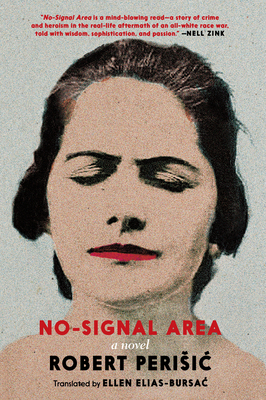
But we start with two city men, Oleg and Nikola, as they roll into the middle-of-nowhere town of N, somewhere in the ruins of a former Yugoslav republic. It’s about fifteen years after the war, and the town of N is suspended in a kind of limbo. The factories are silent, the population stagnant, the wounds of war are too close to the surface, and the future is a foggy concept that never seems to arrive.
But Oleg and Nikola have a dream (or at least a scheme). They plan to revive the local turbine factory, bring jobs, spark hope. Oleg, a charismatic war veteran with murky connections and a questionable past as an arms dealer, leads the charge. Nikola, his cousin, is the aimless Xanax addict who’s along for the ride. They promise the town of N success, maybe even self-management for the workers, a faint echo of old socialist ideals.
But they’re hiding their real motive: a secret deal with a sanctioned North African dictator.
The factory was surprisingly well-preserved. They’d protected the machines. Sobotka knew the entire process and could be trusted. If they weren’t able to make some of the machines work, Sobotka said, they’d need parts from abroad or to produce them themselves. Sobotka gave him detailed instructions, and Oleg made some inquiries. Doable. All in all, it might be even easier that he’d expected
The novel jumps around between multiple characters and perspectives, diving into flashbacks and personal histories. There’s Sobotka, the chief engineer with a artistic soul and a family who fled to Northern Europe; Branoš and Erol, whose war experiences led them into morally questionable territory; and Slavko, the town madman, and the long strange letters from his daughter Nedra, who becomes one of the strangest and most haunting voices in the book. All of them just trying to survive their wounds of war in a world that moved on without them.
“Just because something happened, it doesn’t mean it is over,” Sobotka writes to his daughter. The old rules are gone, but the new ones are invisible, or only accessible to those already inside the system. In the meantime, everyone else is just improvising.
Perišić does an excellent job of capturing this in-between state between socialism and capitalism, between past and future. The story balances beautifully between hopelessness and hilarity and feels rooted in a deep understanding of human nature.
People he met had predatory looks in their eyes, the cynical humor of professionals. He worked with mob bosses, international piranhas, local warlords — the kind of people with whom others didn’t dare make eye contact
That said, the structure is a little loose. In the last quarter of the book, the POV suddenly shifts to alternating first-person, and it sometimes becomes a bit of a struggle to decipher who is actually speaking. Some chapters to me felt more like short stories than parts of a larger whole, and though all of the stories are compelling in their own right, I’m not sure what was gained by that change. It felt a bit like chaos for its own sake.
But by the final chapters, I was fully back on board, and as I said, I mostly loved it.
It’s a complicated, sometimes messy book, but certainly unforgettable. There’s a sense of sadness underneath the cynicism, and a quiet question running through it all: how do we rebuild something meaningful after everything we knew has fallen apart?