
Living in the Islamic Republic is like having sex with someone you loathe
Reading Lolita in Tehran has been sitting on my TBR for years. One of those books I was definitely going to read. Eventually. And finally, eventually arrived.
I had already read Children of the Jacaranda Tree by Sahar Delijani years ago, and several of the other books on my Iranian list turned out to be rather difficult to get my hands on. Meanwhile, there sat Reading Lolita in Tehran, readily available and patiently waiting for me.
I should probably have read it sooner. Because I really liked it.
Azar Nafisi was born in Tehran in 1948 and spent part of her education abroad, eventually earning a PhD in English and American literature in the United States. She returned to Iran in 1979, just as the country was being transformed by revolution, and began teaching English literature at the University of Tehran.
A few years later she was expelled from the university after refusing to wear the mandatory veil, later taught at other Iranian universities, and eventually left Iran for the United States in 1997.
Once evil is individualized, becoming part of everyday life, the way of resisting it also becomes individual. How does the soul survive? is the essential question. And the response is: through love and imagination.
And somewhere in the middle of all this, she started a book club.
Well. Sort of.
After leaving university teaching, Nafisi invited seven of her most gifted former female students to her home every Thursday morning. Behind closed doors, they removed their black veils and overcoats, drank tea, talked and read books together: Nabokov, Fitzgerald, Henry James, Jane Austen.
And Lolita is still Lolita whether you read it in Copenhagen or Tehran. Gatsby still throws his ridiculous parties. Elizabeth Bennet still falls in love with Mr. Darcy. The words don’t change.
But the reader does.
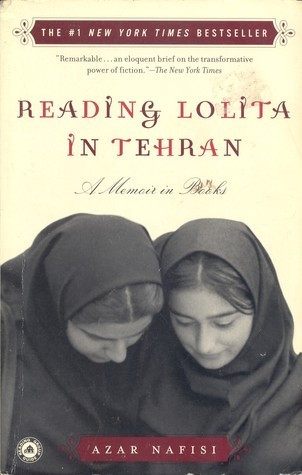
And books about individual freedom, desire, marriage or the right to make terrible decisions for yourself looks rather different when you are reading it in a country where most of those choices are being taken away from you.
Here I am, spending a lot of time deliberately seeking out books from other parts of the world, but Nafisi turns the idea around. Here were Iranian women reading books from my part of the world and finding things in them that I might never have noticed.
I loved that.
However, a slight warning … Nafisi is, after all, a professor of literature. And some of the literary discussions of Nabokov, Fitzgerald and James, with detailed interpretations of characters, themes and symbolism, can become very long. And though I am interested in such things, sometimes my eyes began glazing over …
But what the book contains other than the literary discussions more than makes up for it. Nafisi lived through the 1979 Revolution, the Iran-Iraq War and the transformation of Iranian society under the Islamic Republic. So she writes about demonstrations and bombings, universities becoming political battlegrounds, censorship, compulsory veiling and the strange experience of watching the boundaries of your own life gradually shrink.
This is history barging into people’s ordinary lives.
People fall in love. They marry the wrong person. They argue about books. They worry about exams. They disagree about politics. They make jokes. And outside, governments change, bombs fall and another rule appears telling them what they may wear, read or do.
The novels were an escape from reality in the sense that we could marvel at their beauty and perfection. Curiously, the novels we escaped into led us finally to question and prod our own realities, about which we felt so helplessly speechless.
I also very much liked that her students aren’t presented as one convenient group of “Iranian women”. They disagree. They come from very different backgrounds, and their politics and personal beliefs differ. Some support the Revolution, others suffer because of it. Some of them wear a veil even before the mandate, and som of them fight it fiercely. Even inside this tiny Thursday-morning gathering, there isn’t one Iranian experience.
I think about books as windows into other worlds. That’s certainly a large part of why I’m doing this project. But it is an interesting thought that you can give the same novel to ten people in ten countries, and they will bring ten different worlds to it.
And Reading Lolita in Tehran made me think differently about what it actually means to read literature from another culture.



This sounds fascinating. Thanks for the review, as always.
I chose Shokoofeh Azar’s The Enlightenment of the Greengage Tree. I was hoping it would be easier to handle the horrors there if told from the perspective of a ghost. It kind of was. Like fantasy stories, the magical realism diverged from realistic story telling to talk about such things as ghosts that can still hug the living and eat food, 177 days of black snow, turning into a mermaid, and lovemaking that’s so hot it literally burns the grass beneath. I can see the allure of making scenes of life mythical. And deciding that sometimes the forces beyond (like jinns) enforce retribution when you can’t.
But it’s not my style. I also disliked that it wasn’t chronological. At least there was closure at the end; I like that.
This book is about a family that moved to a tiny village far from Tehran to hide after the daughter died in a fire around the 1979 Revolution. This plan worked for nine years. But then the government still came for the sons–at first enticing them with inspiring patriotic music, but then just grabbing them. Interspersed with stories about the rest of all of their lives were stories about others.
I liked the opening quote: “We are not the first people to have destroyed ourselves; with a city where all devices of felicity were present.” – “Manifest of Desolution” by Bahram Beizai (an Iranian playwright and filmmaker among other things)
I liked the description of what it’s like to be a ghost: “There are a lot of good things about dying. You are suddenly light and free and no longer afraid of death, sickness, judgement or religion; you don’t have to grow up fated to replicate the lives of others. You are no longer forced to study nor tested on the principles of religion or what invalidates prayer. But for me the most important advantage of death is knowing something when I want to know it. Kon Fayakon. [“Be! And it is.” – Quran] Piece of cake. If I want to be somewhere, I am, just like that. I realized all this the day I died.”
I also liked the lesson that “treasures are always jinxed.” Maybe you don’t find the treasure and resort to theft. Maybe your partners kill you so they don’t have to share.
There’s a scene where the father is in a police station, told to write what he knows. He writes his memoir. They don’t believe all the mythological parts, so he “wrote everything again. This time he cut out all the parts he had realized were incomprehensible to their stale minds, and embellished here and there to make it thoroughly believable. This time he wrote nothing about the black snow or my ghost, or Aunt Turan joining the Jinns, or Beeta and Issa’s circular flames of love-making.” (I’m one of those with stale minds!)
There’s a similar message by the end of the story. People with chainsaws came to the village and flattened everything and rebuilt. The villagers became the victim-aggressors—after just trying to survive, “they forgot their myths and dreams, their history and balance and, saws in hand, they themselves attacked the Hyrcanian forest, the forest entrusted to them by their ancestors … [and] thought they had never been happier with their new, air-conditioned houses, mobile phones, vases full of plastic flowers, and shelves stocked with chips, Pepsi, and gum.” It’s a tragic happiness in many ways. Even though I didn’t properly appreciate the mythology, that doesn’t mean I want it destroyed.
What I loved most was the description of a family organizing their books. They had over 5,000 and thought it would take about a week. “…but by the end of that first day they realized how wrong they were. As if it were possible to pick up a book and simply write the classification numbers and letters on its cover and then send it off to a bookshelf! Once they had a book in hand, who knew when they would put it down again? They skimmed through them, allowing passages to catch them like fishing nets and carry them down in to the depths of their sea. They would read sections aloud and discuss them.” Two more folks came to help. “…the situation didn’t much improve, the difference being that now four people were lost in reading. They discussed books they had in hand, argued, wrote notes in the margins, and then had no choice but to temporarily abandon them to continue the classification.” Suddenly I want to have a book organization party!
I actually tried the Greengage Tree first, but I couldn’t get into it. I might try again at some point.
Ah well. The good thing about having a list of ten well-curated books to choose from is that if one isn’t clicking you many more options already picked out. (Especially this time when you already had this book on your TBR!)
After reading The Greengage Tree, I’ve actually started reading the book I chose at the library before checking it out. Especially when more than one option is available at the same library. Doing that I chose differently than I would have otherwise for one country and ended up bringing home two for another country. (More details in my upcoming reviews!)