A woman has neither soul nor intelligence
Did I get your attention?
The line is spoken by a pious Muslim friend of the protagonist in this book, when he asks him for advice on his plans for marriage. And you need to be able to stomach things like that to get through this book …
But I can assure you, that the female love interest in this Azerbaijani classic has both soul and intelligence!
A man must marry, preferably the woman he likes. She needs not like him in return.
The woman is just the acre on which the man sows. Must the field love the farmer? Enough that the farmer loves the field.
“So you believe that a woman has neither soul nor intelligence?”
He looked at me pittyingly: “How can you ask, Ali Kahn? Of course she hasn’t. Why should a woman have either? It is enough for her to be chaste and have many children.
Anyway, I actually ended up liking Ali and Nino more than I thought I would. In a quiet and content “this was actually really interesting” kind of way.
On the surface the book contains a love story between Ali, a young Muslim boy from a distinguished Azerbaijani Muslim family of noble Persian ancestry, and Nino, a Christian Georgian princess. They grow up in Baku, fall in love very young, and against all odds persuade both families to let them marry. All of this is set against the rich and complex tapestry of cultures in Azerbaijan in the early twentieth century.
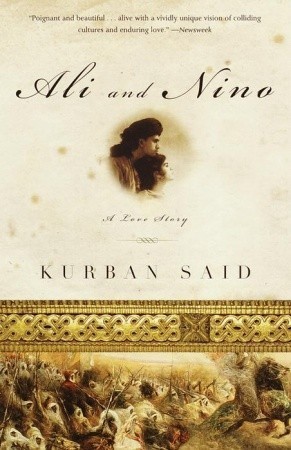
But the romance between Ali and Nino wasn’t the most exciting part of this book for me, because it’s really nothing special. The book has many very beautiful quotes on the nature of love, but the love Ali has for Nino really seems like nothing much outside of adolescent physical attraction, and why Nino loves Ali at all, is honestly a bit of a mystery.
It often feels like the love story is mostly there as an excuse to let the book move around the region and show different places, customs, and ways of thinking. The novel vividly portrays the contrasting worlds that Ali and Nino inhabit. It takes you around the region to Baku, Tbilisi, the Karabakh, Tehran and the mountains of Dagestan, highlighting the clash between East and West, tradition and progress, and religious and secular values.
Ali himself is pulled in different directions. He’s educated in a Russian school and open to European ideas, but he also takes his religion and traditions seriously, especially as the political situation gets worse. Over time, Islam and his Muslim heritage becomes more important to him, and more firmly a part of who he is. And Nino sees these problems very clearly, often before Ali does, and she’s much less romantic about how easy their life together might be.
Our old town is full of secrets and mysteries, hidden nooks and little alleys. I love these soft night murmurs, the moon over the flat roofs, and the hot quiet afternoons in the mosque’s courtyard with its atmosphere of silent meditation. God let me be born here, a Muslim of the Shiite faith, in the religion of Imam Dshafar. May he be merciful and let me die here, in the same street, in the same house where I was born. Me and Nino, a Christian, who eats with knife and fork, has laughing eyes and wears filmy silk stockings.
The Azerbaijan of Ali and Nino is modern and international, full of new oil money and European influence, but at the same time very traditional. Blood feuds and strict ideas about a family’s honour are deadly serious issues, even while people are reading European books, and going to the opera. I learned so much about the cultural tapestry of the Caucasus region from reading this.
Possibly, the most interesting part of Ali and Nino is not the narrative but the question about who wrote it. “Kurban Said” is a pen name, and apparently no one is completely sure who the real author was, but it was first published in Vienna in German in 1937. This Wikipedia article explores the controversy about the author’s identity in great detail. Criticism include people saying that the author is not Azerbaijani at all, and that the novel “reeks of orientalism”. That it is a story of the “wild muslim man”, meant to send shocks and thrills though the ladies in the fine European salons. Romantasy of the thirties, if you will.
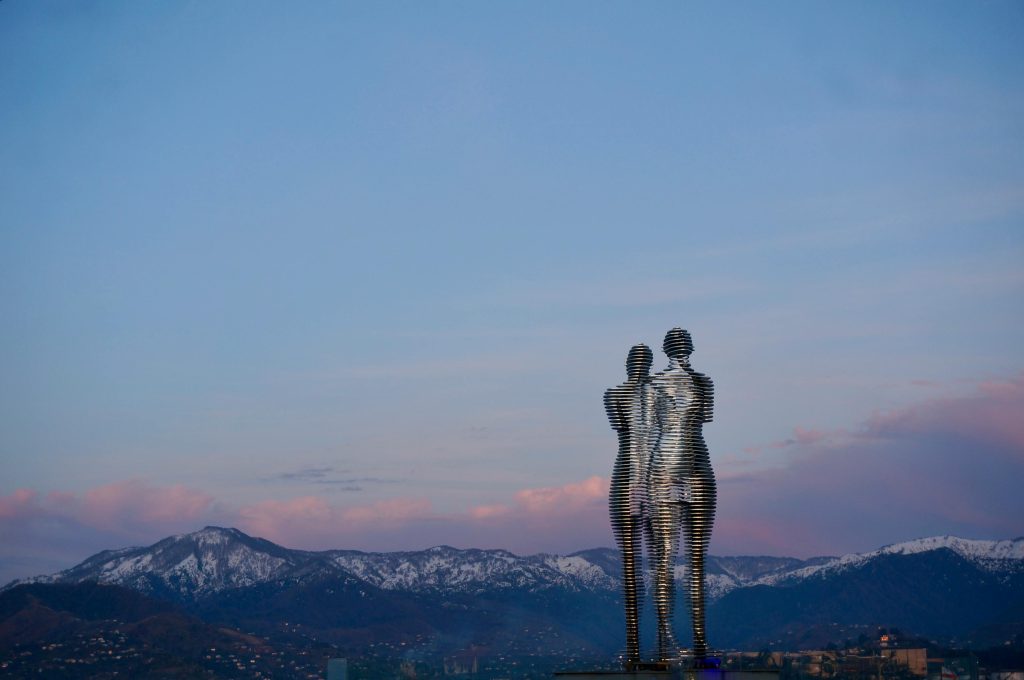
However it does seem that Azerbaijan has claimed this book as it’s own. There is even a moving Ali and Nino sculpture in Batumi, Georgia. I included a photo, but you should definitely look up the video to see the way it moves.
I wouldn’t say Ali and Nino is a book I loved, but I’m still glad I chose it. It definitely made me think about the region in a way I hadn’t before. It’s a bit uneven and a bit strange in places. But it is poetic, exotic and interesting, and I did enjoy spending time with it.