

Productivity is Power
I am very sure that The Ten Percent Thief won’t be for everyone, but this was right up my alley!
I’m often drawn to dystopias, particularly the ones where the future feels uncomfortably plausible. And The Ten Percent Thief gave me exactly that.
The novel is set in Apex City, formerly Bangalore, where the Bell Corporation has created a “Meritocratic Technarchy” built around the Bell Curve, where everyone is ranked according to productivity.
The top Twenty Percent have exceptional privileges and enjoy the best of everything. The Middle Seventy Percent strive desperately to move upwards. Or at least to avoid moving downwards. And the bottom Ten Percent are the Analogs, stripped of all technology and expelled beyond the “Carnatic Meridian” – a force field of sorts splitting the city in two.
Welcome to the future!
He’d experienced sweeping Hyper Reality views from atop the Bell Towers in Crown City, awestruck as its nano-fibre constructions reoriented themselves with clockwork precision. They crested and descended, swivelling to make the most of their solar-harvesting capabilities, absorbing snatches of power from the sunlight that peeked through whips of rain lashing down from the sky.
The book is a mosaic of interconnected stories about people living at different levels of this society. We meet people obsessed with their rankings and carefully constructed social personas; children whose futures depend upon proving their productivity, workers who can never afford to stop performing, rebels, influencers, prospective parents, and people discovering exactly how quickly the system can turn against them. After a while the pieces start fitting together, as the main character of one story shows up in the margin of another and vice versa.
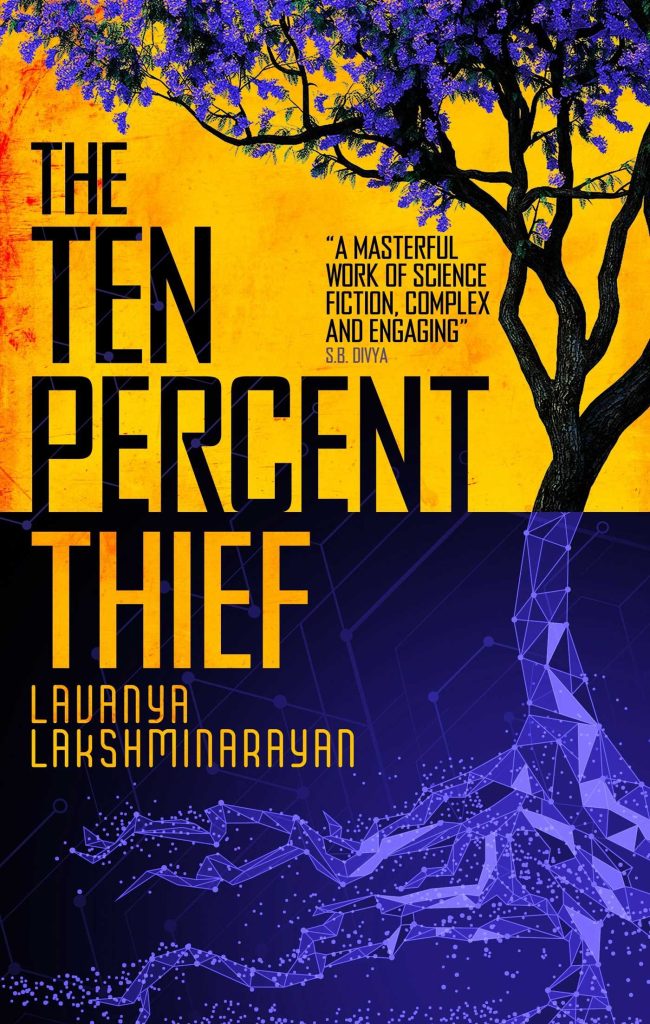
And meanwhile, somewhere in the background, the titular Ten Percent Thief has stolen a jacaranda seed, which will become the beginning of a revolution.
But the revolution plot was almost secondary for me because I was having so much fun exploring Apex City and enjoying Lakshminarayan’s sheer creativity of language.
There are VirtuoPods, OmniPorts, Nebula, InEars and Panopticams. There are Prega-Pods and ClimaTech and Repopulation Wards. There are social platforms like InstaSnap, surveillance everywhere and technology designed to optimise practically every aspect of human existence.
And the corporate terminology is just deliciously sinister. The Malthusian Manifesto. The Pledge of Conformity. The wonderfully Orwellian Opinion Homogenisation Limitation and Alignment Unit.
Who wouldn’t want to live there?
You could say that that the book is not particularly Indian, and you would be right. Apex City could, in many ways, be almost anywhere in the world. And so many of the concepts hit uncomfortably close to home.
We already curate online versions of ourselves. We already count followers, likes, clicks and engagement. Algorithms decide what we see, what we buy and increasingly what we think! AI is rapidly moving into areas we once assumed required humans. We optimise our productivity, measure our performance and willingly carry devices that know an extraordinary amount about us.
What Lakshminarayan does is just to push these things to their extreme conclusion.
What if your social-media persona became more important than the person behind it? What if conformity became measurable? What if AI didn’t merely help you make decisions, but quietly decided what the correct decision was and manipulated your brainwaves until you made that decision? What if the technologies making life easier also became the mechanisms determining your value as a human being?
And what happens to the people who refuse to participate?
The answer lies outside the Carnatic Meridian, where the Analogs live without electricity or running water, scavenging what they can from the civilisation that has rejected them. Even here Lakshminarayan plays wonderfully with language. One of the most chilling examples is the Vegetable Farm – because if you are not productive, you are nothing more than a resource to be harvested …
So. You would be excused to think that this is a relentlessly grim book. But it is not. It is clever, playful and frequently very funny. Lakshminarayan throws invented brands, corporate slogans, virtual worlds and bureaucratic euphemisms at you until it starts feeling completely natural.
The analog world is terrible…
They’re forced to talk to each other in person every single day.
And underneath all that glorious techno-babble, people still fall in love. They still want their children to succeed. They crave approval. They get jealous. They are frightened of losing what they have. They convince themselves that an unfair system must be fair because admitting otherwise would mean questioning their own place within it.
And some people plant seeds.
Literally.
I genuinely loved every weird, clever, disturbing page of this book. The Ten Percent Thief takes our obsession with productivity, social media, technology, status and AI, turns the dial several notches until you reach total absurdity … and then leaves you thinking, that is is absolutely not as far-fetched as it should be.
Five stars. Easily.
But if dystopias are not your thing, here (and also here) are some other options from India.



I chose The Hungry Tide from your first list. I really enjoyed learning about the Sundarbans, the river delta of the Ganges (and other rivers that meet it), also known as the tide country. The many channels and islands within are ever-changing, and many islands flood daily from tides that reach as far as 200 miles inland. I can’t imagine that anyone who learns to feel at home here will feel at home anywhere else.
We get to learn about mangroves—they don’t support diverse wildlife within them, but they do protect land that is upstream. There are crabs who clean the sand, allowing mangroves to survive. There are tigers who hunt humans more than tigers in other regions do, and no one quite knows why. But don’t think the water is safer because there are also crocodiles. Plus the tigers can swim. And then there are the river dolphins, which apparently evolved from the river channel created when the Indian subcontinent first approached Asia and are now found at the ends of the Indus and Ganges rivers originating there. The saltwater and freshwater dolphins don’t interact, but are considered the same species.
We also learn about two idealistic attempts to make life better, one which really happened, and the other strongly based on or inspired by another real one. If you don’t like info dumps, this book won’t be your favorite, but I enjoyed these.
Most of the characters are strongly dedicated to their careers: translating, studying cetaceans, fishing, nursing, and running an aid organization/hospital. It’s almost a miracle they get to know each other at all; they are often exasperated. But when they do, some become better for it. Some characters are strongly inspired by religion/mythology and other poetry. One character says he sees his mother all around him. Another, I suspect, will see him all around her in the future. This can happen when memories are tied to places.
There are plenty of scary situations: A researcher working with a fisherman with no language in common. Tigers. Typhoons. Park rangers (they are heroes in the US right now, but are bad guys in this novel). Human trafficking. And the folks who, when their efforts were declared illegal, just bussed in some criminals to do their dirty work for them.
The book switches back and forth between several narratives, one of which happens in the past, and two of the narratives have different 5-year-old boys, one of whom is the father of the other one, so it takes some work to keep everyone straight. I didn’t quite love any of the characters, though I was sympathetic to all the main characters, so that’s a good trick. I didn’t like that one of my favorite main characters dies (there is foreshadowing, but then I forgot). I do like the epilogue, which is where we get to see that two of the characters have really listened to others and are changing their lives (and other’s lives) for the better, as a result.
One interesting theme was idealism versus practicality. Is it more heroic to stand for your values at all costs? Or don’t you have more real successes when you accept certain limits? The answer in this book seems to be the latter, though you could imagine that taken to extremes that answer would change. There is a fine line that should be continually attended to.
Overall, I’m glad I read this book (thanks for all the recommendations!). I think it will stick with me though I don’t think I’ll read it again. I would read more by this author, though this might be the one I would most enjoy.
I just love it when people pickup a book because of my recommendation. And I didn’t even read this one myself 😀
But you did do lots of lovey research!
The research is the fun part for me 😀
Next I chose U.R. Ananthamurthy’s Samskara: A Rite for a Dead Man about whether a rule-breaking brahmin deserves a brahmin funeral.
Right away I realized I needed to make a list of characters.
The setting is an agrahara (colony of brahmins). These brahmins were all men, and they were all married. The wives and children didn’t have to follow the same rules. I found it kind of fascinating that deeply religious people were allowed to marry and raise families. I like that the different households raised different things on their land and then shared these with each other. It sounded like kind of a great way to live assuming, of course, that you like the other people there.
And most of the rest of this comment is plot spoilers. So if you plan to read the book, ignore the rest, but otherwise maybe you can get some of the benefits of reading it by just reading this.
So one brahmin (Naranappa) had died after having slept regularly with a lowcaste woman not his wife (who he’d abandoned) and having eaten her cooking. He also drank alcohol and he ate animal flesh including fish from the sacred pond. They hadn’t excommunicated him in life, because he’d threaten to turn Muslim, which would have desecrated the whole colony. And our protagonist, the wise Praneshacharya, had still hoped to be able to bring him back to the faith.
That hadn’t happened. So Praneshacharya spent days searching through the religious texts and then praying to the temple god to figure out who should perform the rites, but got no answers. At this point, I was reminded of classes in Medieval European history where there were actual wars about fine points in the Bible that are very hard to imagine being important today. I thought since Naranappa hadn’t been excommunicated and hadn’t converted to Islam, they should just give him the funeral already. But it wasn’t that easy. They might be cut off from other brahmins who didn’t respect this decision if they did that, for example.
But we also look into other questions of good and evil, how to inspire people to be good, and whether and how much good can balance evil.
Pranshacharya had deliberately married a born invalid (he was 16, she, 12) to have a life of self-sacrifice that would lead to a more meritorious life. It’s kind of wonderful to have a society that rewards taking care of invalids, but I could also imagine that getting out of hand. (What if the demand for invalids exceeded the supply?)
One day Naranappa had taken Muslims with him and ‘caught and carried away the sacred fish. Those free-swimming man-length fish, they came to the banks and ate rice from the hand—if any man caught them he would cough up blood and die. At least that’s what everyone believed. Naranappa had broken the taboo. … In this decadent age, common men follow the right paths out of fear—if that were destroyed, where could we find the strength to uphold the world?’ I’ve always been opposed to fear as a strategy for swaying people, especially fear based on lies. This reminds me of some of the anti-drug lessons I got in school. If you make marijuana sound just as dangerous as LSD, and then people try marijuana, they’re not going to trust anything they’ve been taught about any of the drugs.
Chandri (Naranappa’s mistress) thinks prostitutes (like herself) are like rivers, ‘How can sin defile a running river? It’s good for a drink when a man’s thirsty, it’s good for a wash when a man’s filthy, it’s good for bathing the god’s images with: It says Yes to everything, never a No. Like her. Doesn’t dry up, doesn’t tire. Tunga, river that doesn’t dry, doesn’t tire.’
So Praneshacharya left the temple dejected. Chandri saw him, felt sorry for him, and went to comfort him. This turned into sex. The next morning, Praneshacharya told his compatriots he’d given up. And that’s the end of Part I.
In Part II, his compatriots travel to two other people to get advice. The first was an astrologer who was able to determine that the time of Naranappa’s death was malignant, non benign. So they still didn’t know what to do. The second advisor was a guru at a monastery who declared ‘Even if he gave up brahminism, brahminism cannot leave Naranappa. Which means, the right and proper duty is to perform the death-rites. But the impurity must be cleared—therefore all his property, silver and gold must be offered to the monastery, to Lord Krishna.’ Uh huh. Self-serving much?
Meanwhile, one by one, various characters, including Pranshacharya’s wife, get sick and die of, as finally becomes obvious, bubonic plague. And that’s Part II.
In Part III, Pranshacharya decides to journey to wherever his feet will lead him, trying to figure out what to do next with his life. He can’t respect himself as a brahmin after the night with Chandri. Shall he embrace the pleasure he found with her and thus be more like Naranappa himself (and an old school friend who was deterred from the faith much earlier by a prostitute)? In the end, Pranshacharya returns to the agrahara, but still doesn’t know whether he’ll even confess or in fact what he’ll do. It feels like a coming-of-age novel cut off in the middle.
One interesting plot point is that at one point Chandri got a Muslim to secretly retrieve Naranappa’s body and have him cremated. And no one discovered the absence of the body through the entire rest of the book.
On bubonic plague: When one man from a nearby village realized Naranappa (and others) had died of the plague, he made a plan: 1) tell the municipality to remove the dead body, 2) get everyone inoculated, 3) get rat exterminators and pumps, fill the ratholes with poison gas and stop them up, and 4) if necessary, evacuate the people from the agrahara. This was set around the 1930s, and it’s interesting that they had vaccines, but did not universally vaccinate everyone ahead of time. Such a luxury, I now realize.
On marriage: One character (in another town) explains, ‘We can’t let our girls reach puberty, before we find them husbands; we’re not yet that spoiled.’ Many in this book not only had spouses found for them young but actually married young. I guess if you start looking early, you’re less likely to run out of time to find an acceptable match than in all the Regency novels, which is good. But, yikes, child marriage! One gal was married at 8 and widowed at 10.
In the end, I felt I was probably missing something. And I was.
The translator, in his afterword, lists plot problems. First, the answer is in the text: ‘Certain simple ritual modifications and offerings would have solved the problem.’ Second, everyone knows vultures don’t touch plague-ridden rats (in the story vultures were attracted to them). Third, Praneshacharya does not project ‘the integrity of the four states of life.’ He ‘ought to have known better than to marry an invalid, a barren woman who would only cripple him in all the pursuits necessary for an able-bodied, able-spirited brahmin.’
Then there is an interview with the author. This explains a few things that I was missing. The interviewer ‘saw the relevance of the novel as an indictment of people of any religion (though brahmins are used as a prototype here) who think they are superior to the set of spiritual beliefs to which they belong and therefore manipulate it to boost their ego. (I totally missed this!) While Naranappa makes a great show of defying the dictates of his dharma with his wanton ways, Praneshacharya flouts them subversively. By marrying the invalid Bhagirathi, he desecrates his grihasthashrama to bolster his ego: “He oozes smug self-righteousness as he gloats, ‘Good she’s an invalid; I’m ripening well.’ ” Wouldn’t he have matured better if he had chosen to be celibate? While Naranappa putrefies openly, Praneshacharya does so secretly with his self-imposed impotency.’
On Praneshacharya’s night with Chandri, the author explains, ‘Praneshacharya has a whole set of absurd questions before he meets her and a whole set of absurd questions after he meets her. The only thing that is pure in the novel is the meeting. His sexual self is aroused and there is no question of right or wrong, only pure joy.
‘…So, coming back to the novel, when the brahmins are asked to perform the cremation, they refuse to do it, not because they do not want to dispose of the body; they don’t want him as a pithru [spirit of an ancestor].’ He says Naranappa and Praneshacharya are opposite sides of the same coin of willfulness. Another character (who follows Praneshacharya around during his wandering period, just trying to help him out) is the counterpoint, showing willlessness. ‘Any person who lives in willfulness is a person who lives in bad faith or in hypocrisy.’
Okay, I still don’t get the book, probably because I’m pro will. I believe in having goals and trying to achieve them rather than just wandering around being buffeted by life. I like the Girl Scout motto to “Be prepared.” I like vaccines. I vote. I can’t prepare for everything and must adapt to changing circumstances, but I still think having goals is a better strategy for me than not—or maybe I just don’t properly know how to be willless. When I learned that one personality type relied on winging it rather than planning as a strategy, I knew that wasn’t me. I do not have winging skills. I don’t even know how people do it, except for two examples: 1) Couch surfing. 2) Being generous when you have money, which encourages friends to be generous with you when you don’t.
So, I don’t get the book, and that’s okay.
Next, I also chose The Ten Percent Thief. I found it hard to read with a new protagonist in almost every chapter and changing even whether it was told in first-, second-, or third-person. This ‘mosaic’ format, which I’d never heard of before, is like short stories written in chronological order. I often don’t enjoy short stories because they don’t tell me enough, but most of these were fine.
I did like the world building. At first I thought I hadn’t learned a lot about India, except that this story feels very first world, which I admit to not expecting from India, even though I knew Bangalore was a tech center. I did know the problems with status/caste there are much more obvious than here, and it makes sense for their authors to address it.
But then I found Grim Dark Magazine’s interview with the author, where she describes a life that very much parallels the story. She started working in videogames, a high-pressure industry from which she burned out. Bangalore has many fabulous futuristic qualities, with start-ups, virtual reality, and robotics, but also dystopian traffic, water supplies, and stratification. And she watched that disparity get worse during the Covid crisis.
She feels that social media already inflicts some of the kinds of stress that the privileged in her book experience:
…everyone has their view of what constitutes “perfection.”
The fear of criticism and conflict is a massive undercurrent in this space. I think this generates a great deal of pressure to conform to a certain kind of “perfection”—once you’ve declared where you stand, you need to constantly perform this stance or you’re subject to scrutiny.
Back to her book, it fascinates me that a meritocracy was set up, although by a for-profit company. And even though merit seems a much better way to sort people than random things like race or religion, people are still sorted, and the definition of ‘merit’ is not decided democratically in this culture.
On merit: I love that China long ago switched to a merit-based system for government jobs over a heredity-based system. And I remember when I first learned that teachers’ unions (in the United States) opposed merit raises. I was horrified. Then I learned that in real life, ‘merit’ often ended up being defined as whoever sucked up to the principal the best. And I saw at my own employer that the ones who got merit raises were often the ones who were already making the most money—in many departments, the underlings just assumed, correctly, that they would never get merit raises. It’s easier to measure something like longevity in a fair and predictable way than something like merit. (For teachers, at least you could look at the improvement in test scores—that’s predictable and relevant—but then it’s much harder to improve the test scores of students who start out great, and those students do deserve good teachers, too.)
On bell curves: I once had a boss’s boss who was, like the Bell Corp, focused on the bell curve. He wanted, for example, only the top 10% to get the good raises and wanted to call the bottom 50% below average. And yet, of course we did try to hire only above-average people. We didn’t like that no matter how amazing our team was, certain people had to be stamped as ‘below expectations.’ In my ideal society, you just try to help everyone be as good as they can be.
In the book, whenever people moved up in society, others had to be moved down, and vice versa, to keep the percentages constant. That’s pretty creepy. Yet, I also didn’t know if the population were being told the correct percentages—I wondered if perhaps the top 20% was really only 5% of the population, the middle 70% only 45% and the bottom 10% really 50%.
I like the way the book shows you people at all levels of society, especially at the boundaries, both on the way up and on the way down. Society used both the carrot and the stick to encourage people to maximize their productivity. The stick was pretty horrifying, but it seems especially rude when some of the decisions were so random. (Being unable to make even one mistake seems crazy. People can learn from their mistakes. People who make a mistake can still be smarter and wiser than your other options.) And these movements also broke families apart.
I enjoyed this character description:
All men and women are given a choice—to be the hero of the tale or its teller. Bashir Rehan is content with the latter. He’s often been told that he should run for office, that he would make a formidable Suzerain of one of the tribes. He’s never held this desire himself.
His fulfillment is derived from an audience that hangs onto his every word. He prefers for those words to be fictions rooted in the moment, not promises for a better tomorrow.
…As with Samskara, I really wanted to know what happened next. Not only whether there ended up being a lot of fighting and whether the society in general recovered into something workable without a huge percentage of people dying after ClimaTech was deactivated, but also questions about specific characters. Like does Teresa the tour guide ever get to see her sister again? Does Ro the spy get to see her parents again? Does Aditi successfully remove M.I.M.E.S.I.S. from her brain and stay with Abhay?
Overall, I’m glad I read the book. Thanks again for sharing!