
They don’t allow flat-footed Arabs on the moon
This was very different from what I imagined when I picked it up.
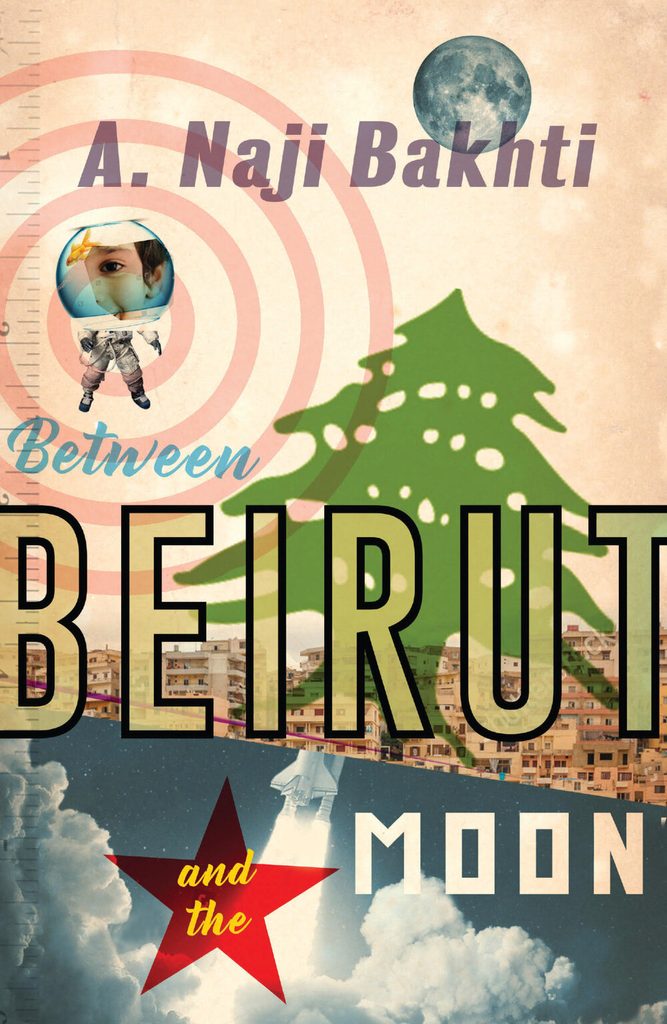
From the blurbs, I was expecting something humorous and light. A quirky coming-of-age story about a Lebanese boy who dreams of becoming an astronaut, despite the rather obvious obstacles to launching a space career from Beirut.
And there is humour. Many genuinely funny scenes, and plenty of colourful characters bordering on caricatures. Mainly Adam’s journalist father, who lives with books stacked to the ceiling in perilous towers. But also the possibly pedophile poetry teacher. The schoolmate who does 4-digit multiplications in his head to relieve any kind of tension. And Adam’s gloriously irreverent mother, who responds to another mother criticising Adam’s technique during Muslim prayers by telling him to perform the Macarena instead.
But around these characters the book deals with some very heavy subjects!
The two biggest deals in the region today are sex and religion,
and unfortunately for us, they don’t get along very well.
Adam grows up in Beirut in the aftermath of Lebanon’s civil war. His father, the book hoarding journalist, is Muslim, his mother Christian, and his best friend belongs to the Druze community. Religion, politics, bombings and the country’s troubled history are woven into the very fabric of his childhood, alongside school, friendships, girlfriends, family arguments and the universal awkwardness of growing up.
As a small child Adam dreams of going to the moon, but this fact actually plays a much smaller role in the book than I imagined from the description and the title.
Between Beirut and the Moon is the author’s debut novel, and though it is not autobiographical, it does draw heavily on his own experiences of growing up in postwar Lebanon. Bakhti was born and raised in Beirut and later moved to England, where he studied creative writing.
I spent the first half of the book waiting for some kind of plot before finally accepting that there wasn’t really going to be one.
Instead, Bakhti gives us episodes from Adam’s childhood and adolescence. Some are funny, some are touching, and many are downright disturbing. Together, they paint a picture of growing up in a country where the past is never quite past, and where violence, religious tensions and political instability are part of everyday life.
I was personally a little thrown off by this episodic nature of the storytelling and the jumping around in time. Especially towards the end of the book, when I personally found the chronology increasingly confusing.
I do understand what Bakhti is trying to do, and I can appreciate the idea of building a portrait of a childhood through memories and scattered experiences which change their meaning with time and knowledge. He does it well. But sadly, I never really felt pulled into the story or cared particularly much about these characters.
A couple of barren street lamps adjusted their posture momentarily and saluted my footsteps without lighting them. For the most part they stood repentant by the side of the road. One of them leaned forward as if permanently on the verge of whispering a secret into the ear of an uncoming pedestrian.
What I did enjoy was Bakhti’s writing.
His prose is in places very poetic in a way I haven’t experienced anywhere else. There’s something about the rhythm of his sentences and the way he plays with words that is quite wonderful. Several times I found myself pausing over a paragraph (like the one quoted here about the street lamps) just to enjoy the playful language.
It’s a curious experience, enjoying the writing without particularly enjoying the story. But that was where I found myself with this one.
And more than anything, Between Beirut and the Moon left me with the shameful realisation that I know woefully little about Lebanon.
The civil war? The complicated religious divisions? The Druze religion, which I had never even heard of before? The relationships with Syria and the various armed and rebellious groups? Lebanon’s history with France, Britain and Palestine?
I finished this book with an “I must study this”-list a mile long.
And that, in itself, makes it worth reading.
But there are many other interesting options to choose from for Lebanon.

I have often found myself enjoying the writing without much enjoying the content. It takes so many different skills to write a book; it makes sense that we could like how good people are at one of them without appreciating what they do in the other areas as much.
Something Wicked This Way Comes is a book like that for me. I’ll actually go back and read it sometimes even though I never remember what it’s about.
I chose Rabih Alameddine’s The True True Story of Raja the Gullible (and His Mother). I thought the humor would make it easier to read than some of the other books I’ve been reading. That was true, even though, being exaggerated insults, it wasn’t my favorite kind of humor.
As with your choice, this book was different than I’d expected. I’d thought it would be mostly set in America, where we would be reading along as Raja wrote his memoir. Nope.
Also, as with your choice, I found this disturbingly not chronological. In an NPR interview, the author says “the way that I tell stories is usually the way that I write. And I have never told a story going from point A to point B. There’s always many digressions going back and forth and up and down and sideways.”
And yet, this is my favorite book I’ve read for this project this month. You can read my review on my blog. Thanks again for sharing your project!
I started Raja! I read the first chapter or maybe two, but I simply could not get into the humor. I just did not find it funny at all.
I also thought that it felt more American than Middle Eastern. So I dropped it, which is something I very rarely do.