
A good wife should understand
Let’s be honest. No one outside of North Korea reads Friend by Paek Nam-Nyong for the plot. You choose to read it because it is the only state sanctioned novel published inside North Korea, which is in fact available in English. The novel was a bestseller in North Korea and was also adapted for tv. Surprisingly then, the Surpreme Leader is not mentioned at all in this book, which instead focus on the lives of ordinary people.
The main character of Friend is an elderly judge, Jeong Jin Wu, who is approached by Chae Sun Hee, a famous singer from the Provincial Performing Arts Company. She begs him to let her divorce factory worker Lee Seok Chun, her husband of ten years, because they are no longer on “the same rythm”. And her husband agrees. Seems like a simple case.
But in North Korea, it appears, divorce is not a simple case of two adults deciding to part ways. So instead of simply processing the paperwork, our mr. judge inserts himself deeply into the couple’s marriage, rescuing their neglected child Ho Nam from the rain, interviewing colleagues, neighbors, and family members in an attempt to save the relationship. While he himself struggles with the fact that his own wife abandons him for large periods of time, because she is a scientist who does research on the art of growing vegetables in a far-away mountain village.
Eun Ok, completely moved by Jeong Jin Wu’s commitment, gazed into his eyes and promised eternal love, a harmonious family, and positive results from the research lab.
The point of view of Friend continues to shift between the judge and the two wannabe divorcees, telling their stories in flashbacks.
This entire premise felt completely absurd to me from the very beginning.
And yet… I kept reading.
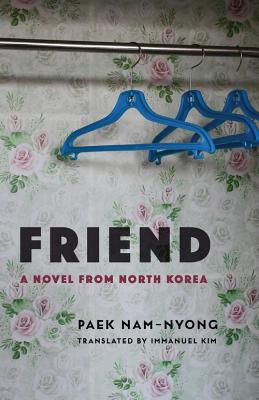
Because as absurd as it might read to us, it is plausible that this was the actual reality of North Korea in the 80ies. The book offers such a rare glimpse into literature actually written inside North Korea. A country most of us encounter the country through documentaries, news reports, political analysis, or memoirs by defectors. Reading an actual North Korean novel feels like peeking through a tiny crack in a very closed door.
Everyday life appears in strange little fragments: apartment blocks, factory culture, workplace ethics, musical performances, social expectations, and constant discussions about duty, collective harmony and self improvement for the greater good.
The reading experience itself, though, was honestly a struggle. The language felt stiff and repetitive, the propaganda was subtle but relentless, and the misogyny nearly drove me up the wall. Again and again, the narrative circles back to the idea that a “good” woman should be endlessly patient, emotionally accommodating, and supportive of her husband no matter how neglected she feels herself. Whenever a wife expresses frustration, the book treats it as selfishness or immaturity rather than something understandable. I spent large parts of the novel wanting to shake nearly every character.
Comrade Judge, don’t you agree that the relationship between a family and the nation is interlinked? Think about it. Can a woman who sings so passionately about the nation be the source of her family’s troubles? No, she can’t. She would be a hypocrite, and we all know that a hypocrite cannot move her audience the way a genuine singer can. Sun Hee sings genuinely and, therefore, cannot be the cause of her failed marriage.
But the worldview underneath it all is undeniably still interesting. Marriage is not a private relationship between two people. It is a matter of coworkers, neighbors, and the state itself. Personal happiness is secondary to social stability and collective responsibility. One must do well in marriage for the good of the country. Emotional conflicts then are treated like workplace problems that can be solved through proper ideological guidance and self-reflection.
I can’t honestly say I enjoyed reading Friend. Though there were small glimmers of what I guess you could call a beautiful love story, it was frustrating, preachy, and emotionally distant for most of its length.
But again, I doubt many people pick up Friend because they expect a gripping literary masterpiece! The value of this book lies more in it being a window into North Korean culture, social expectations, and state-approved literature. And for that, I recommend it.
If you’re not sold on the idea, here are some other options for North Korea.