I all my life I have only one regret
I don’t usually reach for memoirs, but sometimes a book simply lands in your lap at the right moment. That was very much the case with The Noodle Maker of Kalimpong, which I picked up mostly because it was readily available and curiosity got the better of me. I told myself I would just take a quick look before I went hunting for The Handsome Monk or one of the other fictional options I had lined up for Tibet.
And then much to my surprise I found myself hooked almost immediately.
Gyalo Thondup is not just any narrator. He is the elder brother of the 14th Dalai Lama and for decades acted as an unofficial envoy for the Tibetan cause. The book goes back to his childhood in rural Tibet and the election of his brother as the new Dalai Lama. And it then traces Tibet’s modern struggle through his eyes: the Chinese takeover in the 1950s, the failed armed resistance, the shadowy CIA involvement, and the long, frustrating attempts at negotiation with the Chinese.
And he is very much talking from inside the room where it happened. (Hamilton references, anyone?)
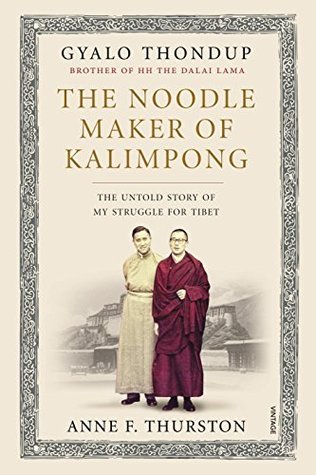
Thondup’s personal life reads almost like a political thriller. He grew up in poverty, studied in China under the protection of Chiang Kai-shek, shuttled between world leaders, helped arrange the Dalai Lama’s asylum in India, and worked with the CIA during its ultimately unsuccessful support of Tibetan resistance fighters. There is plenty here about backroom diplomacy, miscalculations, and shifting alliances.
And very little of it paints anyone in particularly flattering colours!
Gyalo Thondup refuses to turn anyone into simple heroes or villains. China, obviously, does not come off well. But neither do the Tibetan ruling elite, the CIA, or the Indian government. Thondup is very blunt about missteps, failed strategies, and political naivety including his own. That messiness gave the story a feeling of credibility for me. This doesn’t read like polished myth-making. It reads like someone looking back over decades of very complicated decisions and alliances and occasionally wincing at his own actions.
The most important lessons I learned from those his studying Chinese history was “never in five thousand years had Tibet been part of China, and no Chinese historian had ever made that claim”. Nothing I have learned since has suggested otherwise.
For someone like me, who has only ever had a rather blurry overview of the region, this book really did help a lot of scattered pieces fall into place. It gave me a much clearer picture of the tensions between Tibet, China, Mongolia, Taiwan – and also the wider tensions involving India, Nepal, Bhutan, and Cold War world politics. It’s complicated (to put it mildly), but the memoir makes the web of relationships much easier to grasp.
I especially appreciated the foreword and afterword by Thurston, which explicitly remind us that this is but one man’s version of events. Memory is fallible, perspectives are shaped by personal involvement, and some of Thondup’s claims are, by his own admission, very controversial.
And it’s just a really gripping story!
In terms of readability, this is so much smoother than I expected a politically heavy memoir might be. The book has a clear narrative flow. It moves briskly across decades and continents, but even when the geopolitics become dense, the personal angle keeps things very grounded.
In all my life I have only one regret, my involvement with the CIA … it only sought to stir up trouble and use Tibetans to create misunderstandings and discord between China and India.
The book was published in 2015. It ends on a very hopeful note, so it is quite sad to see how now, 11 years after publication (and one year after Gyalo Thondup’s death) most of the tensions he describes are still left unsolved. Tibet still faces human rights issues, surveillance, tight restrictions on religious practice and Tibetan-language education and large-scale relocation programmes, officially framed as poverty alleviation and environmental protection but widely criticised by as cultural assimilation attempts.
At the same time, the broader Himalayan region remains geopolitically sensitive, with periodic tensions along the China–India border. And don’t even get me started on the re-emerging of Cold war politics in later years. This is very much an ongoing story.
So yes, many of the knots this memoir describes are still tightly tied.
I picked up The Noodle Maker of Kalimpong almost by accident. I finished it feeling like I finally had a much clearer mental map of a region I’ve long only half understood. It’s not neutral. It’s not the whole story. But it is a rare, insider perspective that makes a very complicated history feel human-sized.
For me, that made it a surprisingly absorbing detour into memoir territory, and the perfect wrap-up of this region!
And The Handsome Monk and several other interesting options for Tibet go on the TBR for next time …